

This guest post was written by Emmy Wisz. Emmy is a PhD student in the Physics Department at the University of California, Merced. Her research involves leveraging statistical and machine learning methods alongside ground-based photometric surveys to better understand Ultra-Massive Galaxies. She is also passionate about astronomy outreach and works closely with her university’s undergraduate astronomy club to develop nighttime observing programs to serve the Central Valley of California.
Paper title: The diverse quenching pathways of post-starburst galaxies in SDSS-IV MaNGA
Authors: Ho-Hin Leung, Vivienne Wild, Michail Papathomas, Adam C. Carnall, and Yanmei Chen
First Author’s Institution: School of Physics and Astronomy, University of St. Andrews, Scotland
Status: Published in MNRAS [open access]
When it quenches the gas away…
Large-scale surveys have shown that galaxies can build up large amounts of stellar mass and then become quiescent, meaning that they are no longer actively forming stars, well before the Cosmic Noon (~2-3 billion years after the Big Bang, when global star formation in the universe peaked). However, simulations struggle to build up this amount of stellar mass in galaxies and then quench star formation before Cosmic Noon. These populations of massive quiescent galaxies (MQGs) suggest that we should be able to catch some galaxies right after they become quenched– they have been stripped of the gas necessary to form new stars. Understanding why galaxies are quenched is an important step in understanding the evolutionary processes that could have formed MQGs, but quenching is a complex process with a variety of potential causes. Galaxies that have been recently quenched give astronomers the opportunity to study possible quenching mechanisms in more detail.
Post-starburst galaxies (PSBs) are a type of galaxy that have been recently and rapidly quenched following a period of enhanced star formation. In their spectra, this is evident via the presence of strong Balmer absorption lines but a lack of emission features that are typical of star-forming galaxies, indicating that the galaxy’s active star formation has recently stopped and still hosts a relatively young stellar population. In imaging, they appear relatively blue in color, similar to younger, actively star-forming galaxies. These unique galaxies only make up about 1% of the known galaxy population at low redshifts, but they play a key part in building our understanding of this process since they may still have signatures indicating what caused the quenching.
To explore possible quenching mechanisms, the authors investigated 86 PSBs found in the SDSS-IV MaNGA Survey, a large-scale integral field unit (IFU) survey of nearby galaxies. Think of an IFU as many telescopes bunched together that take simultaneous spectra in each pixel of an image. Inspecting spectra across the face of a galaxy allowed the authors to identify specific regions of each galaxy that actually display the bulk of the post-starburst characteristics. They focused specifically on two classifications of PSBs identified in Chen et al. 2019:
- Central Contiguous Post-Starburst Regions (CPSBs): the post-starburst region only appears in a central contiguous zone
- Ring Post-Starbursts (RPSBs): the post-starburst region forms a ring around the centroid of the galaxy
Armed with these two classifications, the authors set out to answer the question “do PSBs with different spatial distributions of PSB regions have distinct quenching mechanisms?”
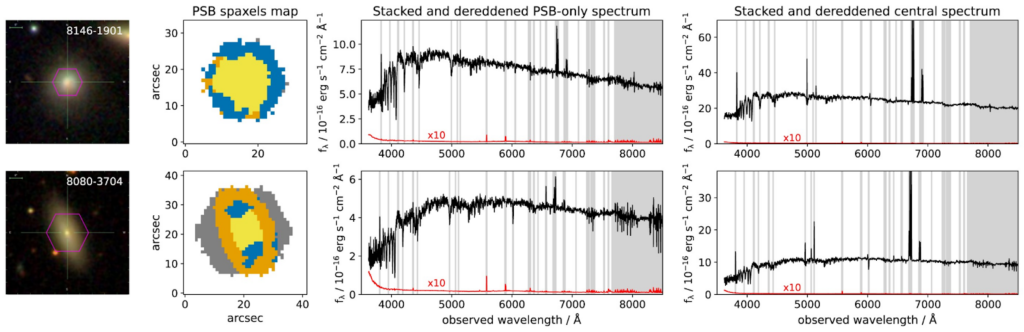
For each PSB, the authors obtained the star-formation history (SFH), stellar metallicity evolution, and dust attenuation of the different regions within the PSBs. This was done using the Bagpipes Python package to conduct Bayesian full spectral fitting on the spectra (example shown in Fig. 2), a method that allows the specification of model parameters that generate high-quality spectroscopic fits used to generate SFHs and measurements needed for this analysis.

TL;DR: Do different PSB configurations have different quenching histories?
Yes! PSBs with different spatial distributions of PSB regions do have different quenching pathways, and it is likely that RPSBs can evolve into CPSBs over time, depending on the mechanisms driving the starburst event.
When the PSB quenching started in a ring, it’ll probably turn outside-in
The key here is that some RPSBs can evolve into CPSBs over time! But how is that possible?
There are two possible ways for this to happen. The authors focused their analysis on the RPSBs and were able to recreate four possible timelines to explain the nature of the ring PSB region; the different types are shown in Fig. 3. The varying SFHs lend themselves to different underlying mechanisms that could have kick-started the quenching process. For the RPSB to CPSB pipeline, galaxy mergers are high on the list. As the galaxies interact, an inflow of fresh metal-rich gas could kickstart the starburst period, followed by quenching in the outskirts as the gas flows inwards. For example, let’s look at the Type I scenario from Fig. 3. The central region begins with some amount of gas that diminishes over time, while the outer region has almost no star-formation for much of the history until there is a rapid jump in activity. This rapid jump in star-formation activity in the outskirts of the galaxy could be the result of a merger bringing in fresh gas to turn into stars.

So, different types of PSBs are linked to different SFHs, and there is a likely evolutionary track between some RPSBs and CPSBs. Our current formation model of galaxies follows an inside-out process, where the central regions of galaxies form first, followed later by the outer regions, so it makes sense that different regions of a galaxy could experience quenching on different timescales. For both Type I and II (top two panels of Figure 3), the RPSBs could evolve into CPSBs as the central region quenches further, while the stellar population in the outer region evolves into a quiescent state, transforming such that the central region exhibits PSB qualities and the outer region does not. Although this is one explanation for quenching in PSBs, the authors emphasize the importance of not oversimplifying, as they find multiple possible explanations for the PSBs analyzed in this work. The four options shown in Fig. 3 are only a handful of the physical processes that could characterize different types of PSBs– two of which show forms of RPSBs that cannot evolve into CPSBs. Higher resolution statistical surveys and development of simulations are required to reproduce the diversity discovered here.
Astrobite edited by Nathalie Korhonen Cuestas
Featured image credit: NASA
