
Paper Title: An evolutionary continuum from nucleated dwarf galaxies to star clusters
Authors: Kaixiang Wang, Eric W. Peng, Chengze Liu, J. Schristopher Mihos, Patrick Côté, Laura Ferrarese et al.
First Author’s Institution: Department of Astronomy, Peking University, Beijing, China
Status: Published in Nature [closed]
This guest post was written by Pradyumna Sahdu, a fourth-year graduate student at the University of California in Riverside. He is interested in learning how galaxies evolve in complex cluster environments using numerical simulations. Apart from doing research, he also loves spending time talking to people about it. In his free time, he enjoys exploring Carnatic music, which is an intricate classical music form from the southern part of India.
Imagine spotting a distant hilltop glowing with lights in otherwise pitch-black surroundings. You suspect a settlement exists, but the darkness hides any path connecting it to the world you know. The only way to confirm it and see how people reached it is to wait for a passing light and watch travelers trace the route through the darkness.
Astronomers faced a similar puzzle when studying ultra-compact dwarfs (UCDs) – dense stellar systems (see Figure 1 below) that have baffled researchers for over two decades. We see these bright, compact objects, but their formation and connection to other known galaxy populations has remained a mystery.
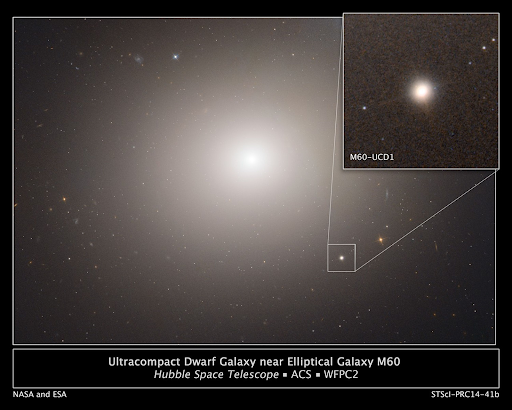
So what exactly are these UCDs? These objects are between 100 and 300 lightyears across, with tens of millions of stars packed into such a small volume, making them some of the most massive compact star systems. For context, the stellar disk of our Milky Way galaxy spans 100,000 lightyears, making it 500 times the size of a typical UCD. Explaining the presence of diverse dwarf systems found in observations plays a critical role in advancing our understanding of how galaxies form and evolve.
The origins of UCDs are unclear. They are too massive to be classified as regular star clusters. On the other hand, they are 10-100 times more compact than normal dwarf galaxies. Previous research found that UCDs sometimes contain supermassive black holes (which possibly accrete!) and signs of the presence of dark matter – pretty unusual for such tiny galaxies! Interestingly, UCDs are also typically discovered in massive environments like galaxy groups and clusters. These groups and clusters are known for their strong tidal forces, the same kind of gravitational stretching from the Sun and Moon that causes tides in Earth’s oceans, but on a much grander scale. This hints that UCDs could actually be the leftover nuclear star clusters of dwarf galaxies that got “tidally stripped” of their outer stars, likely after some intense galactic encounters.
If UCDs form through tidal stripping, there should be galaxies that appear intermediate between regular dwarfs and UCDs, both in their stellar mass and size. As a dwarf galaxy with a nucleus is stripped of its outer stars, it gradually loses both mass and size (imagine an onion getting its outer layers peeled off one by one). But there’s a challenge: the galaxy’s outer regions become more diffuse and fainter as stripping proceeds. These “in-between” systems are thus tough to spot in most surveys, because the envelope of stars around the central bright nucleus is often to faint to stand out unless the observations are sensitive enough to detect very faint light.
Thanks to deep observations from the Next Generation Virgo cluster Survey (NGVS), a smooth sequence has been observed between the known classical dwarfs all the way down to UCDs. Today’s paper focuses on 106 dwarf galaxies in the Virgo galaxy cluster that structurally lie between a UCD and a typical dwarf galaxy. In Figure 2, the typical (normal) dwarf galaxies are marked by gray diamonds. But what’s really exciting are the galaxies highlighted in cyan and magenta diamonds. They represent objects that are intermediates as they transition toward becoming UCDs, gradually losing their outer layers. The UCDs themselves are shown with yellow circles, giving us a probable evolutionary sequence.
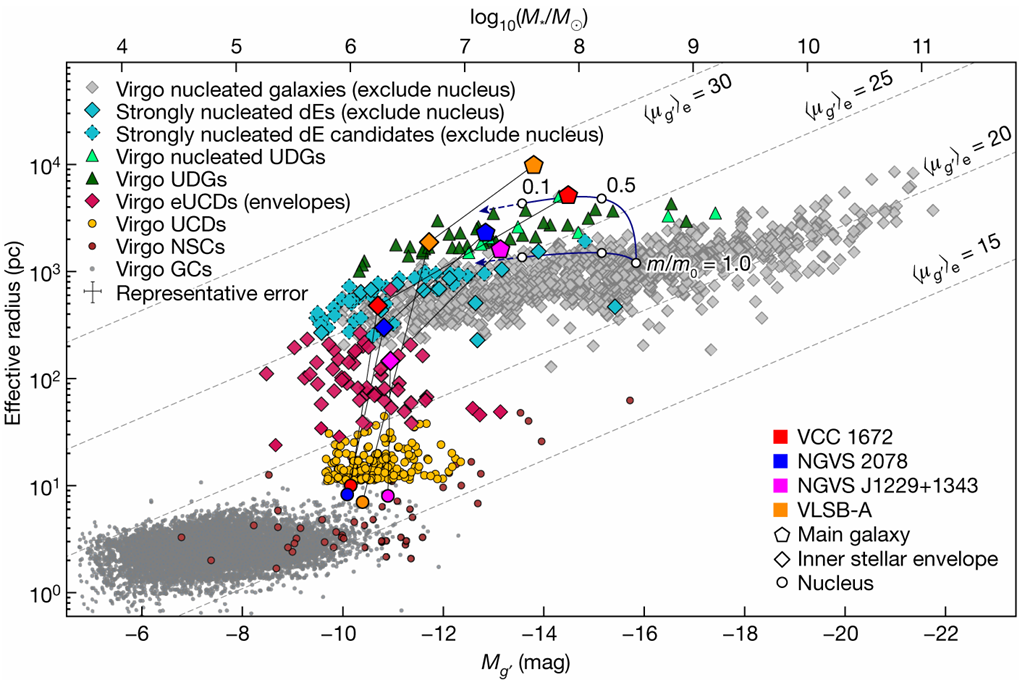
The observation of these intermediate structures supports the formation of UCDs through tidal stripping. But why do we have such diversity in sizes and masses when all of these objects are in the same Virgo galaxy cluster? Galaxies have varying masses, fall into the cluster at different points in time, and don’t follow the same orbits. Because of this diversity, we catch them at various points along this evolution. Some are still intact, some are in the midst of being stripped, and some are already whittled down to their compact nuclei.
A big part of science is constantly questioning our ideas. Today’s authors gained more evidence in this work to support the idea that UCDs form through tidal stripping. They examined where these galaxies are located within the Virgo cluster and found a clear trend: galaxies further along the evolutionary sequence tend to be found closer to the dense cluster center, just where tidal forces are strongest.

The authors also analyzed the color-magnitude diagram, shown in Figure 3 above. The cyan and magenta systems, which were ideated as intermediates of a normal dwarf galaxy evolving towards a UCD, are statistically redder than the normal Virgo dwarf galaxies. This adds more evidence that these systems evolved from an initially more massive parent after losing a significant amount of mass as they transitioned to their current forms.
The next step will be for theorists to test the feasibility with detailed computer simulations. Can current models of galaxy evolution replicate this kind of tidal transformation? It’s a complicated task, since the evolutionary sequence indicates that a dwarf galaxy’s radius can shrink by about a factor of 100 while undergoing a negligible change in its mass. It is gripping to see if future simulations can actually explain this evolution. Alternatively, this might inform us of previously unknown properties of the dark matter, which might be needed to explain such an evolutionary track.
These discoveries make the future of galaxy evolution research especially exciting. New data from the Euclid mission, Vera C. Rubin Observatory, and upcoming telescopes like the Roman Space Telescope will be game-changers for studying the faintest features of galaxies. With their unprecedented sensitivity, these missions will help astronomers spot even fainter regions of galaxies and uncover new secrets of tidally disrupting galaxies, possibly even revealing entirely new types of stellar systems we have not yet identified.
Astrobite edited by Brandon Pries
Featured image credit: Figure 1 from today’s paper
