
Title: A Thick Volatile Atmosphere on the Ultrahot Super-Earth TOI-561 b
Authors: Johanna K. Teske, Nicole L. Wallack, Anjali A. A. Piette, Lisa Dang, Tim Lichtenberg, Mykhaylo Plotnykov, Raymond T. Pierrehumbert, Emma Postolec, Samuel Boucher, Alex McGinty, Bo Peng, Diana Valencia, Mark Hammond
First Author’s Institution: Earth and Planets Laboratory, Carnegie Institution for Science, Washington, USA
Status: Published in The Astrophysical Journal Letters [open access]
Oh, exoplanets, what became of your “wings”?
Some exoplanets — known as ultra-short period (USP) exoplanets — orbit so close to their stars that their surfaces reach thousands of degrees, hot enough to melt rock into vast oceans of lava. Sound familiar? Like Icarus, whose wings melted when he flew too close to the Sun, these exoplanets are trapped in their own blazing “prison”.
Under extreme stellar radiation, USP exoplanets face what we might call an “Icarian fate”: not only do their rocky surfaces melt, but the intense heat from their star also boils off atmospheric gases, transferring so much energy that these gases escape the planet’s gravity. In a sense, these exoplanets lose their “wings”, just as Icarus did, unable to survive the relentless heat of their star.
TOI-561 b, what are you?
Among the population of known USP exoplanets, most behave as expected: their bulk densities, derived from mass and radius measurements, suggest they are small, dense, and likely stripped down to bare rock. Without a significant atmosphere to inflate their size, their densities should resemble that of Earth, reflecting a composition dominated by silicates and iron. However, a handful of these worlds defy these expectations, exhibiting surprisingly low densities — lower than what we would anticipate for an Earth-like composition. So, if these exoplanets are truly bare rock, how can they appear so underdense?
One possibility is that they have an unusual internal structure. For instance, they might lack a large iron core, which would normally contribute significantly to a planet’s overall density. Without such a dense core, the exoplanet would appear lighter for its size. Another possibility is that these exoplanets may not be bare after all, but instead covered by a substantial atmosphere that increases their apparent radius and lowers their inferred density. One such curious world is TOI-561 b.
To put TOI-561 b’s extreme nature into perspective, think about Mercury in our own Solar System. Mercury orbits our Sun (a G-type star) at a distance of about 0.39 AU, heated by intense radiation yet still maintaining a solid, rocky surface. TOI-561 b, by contrast, revolves around its own G-type star at roughly 0.01 AU — more than 30 times closer — exposing it to the extreme equilibrium temperature of about 2300 K. At such proximity, TOI-561 b should be a perfect example of a stripped, atmosphere-free world. Yet, its relatively low density and high temperature prompted the authors of today’s paper to observe it with the James Webb Space Telescope and, for the first time, probe the exoplanet’s atmospheric properties.
What if your “wings” had not melted?
To begin with, the team observed the planet during four eclipses, as it passed behind its star. They then split these observations into seven wavelength ranges (called bins) and analyzed how the planet’s light changed across them. By comparing the combined light of the star and planet before the eclipse with the star’s light alone during the eclipse, they isolated the planet’s contribution in each bin. This allowed them to determine how much light the planet emits at different wavelengths, thereby constructing its dayside emission spectrum (see scattered points in Figure 1).
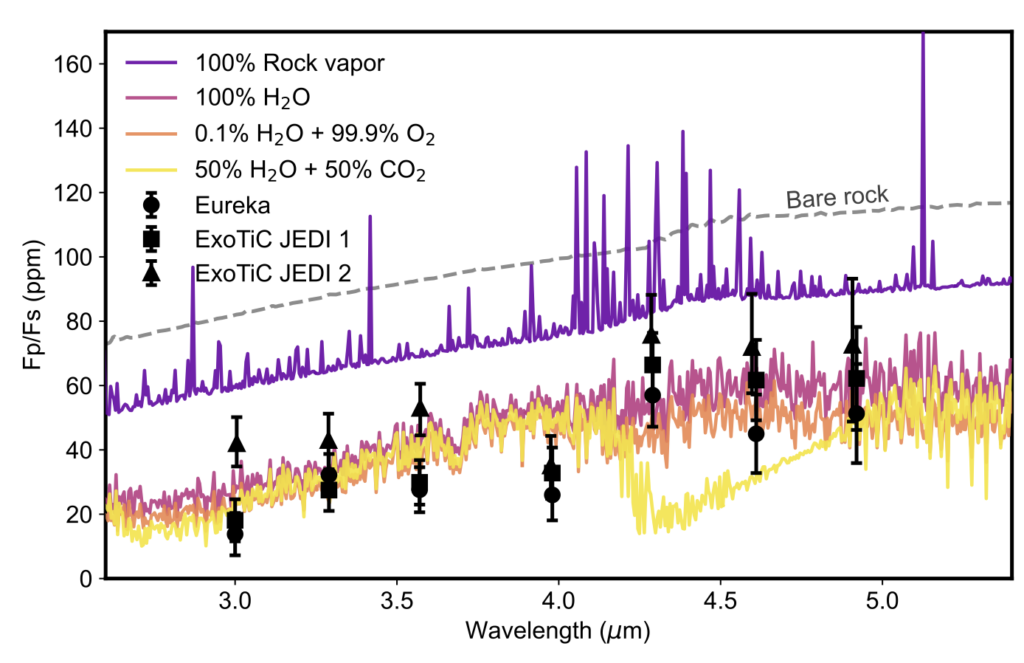
To uncover what TOI-561 b is truly like, the authors modeled a range of possible scenarios (see the different lines in Figure 1) to see which could reproduce the observed spectrum. They considered a bare, rocky exoplanet with no atmosphere, as well as exoplanets with thick, volatile-rich atmospheres, which are dominated by easily vaporized substances known as volatiles. These atmospheres included one made of pure water vapor, another mostly oxygen with some water, and a third a 50/50 mix of water and carbon dioxide.
They also looked at a rock vapor atmosphere, which is composed solely of material vaporised from the planet’s molten rock, with no additional volatile components. Unlike the thick, volatile atmospheres, this rock-vapor atmosphere is thin and unable to transport heat efficiently to the nightside, leaving the dayside extremely hot and producing higher emitted flux across all wavelengths. As a result, the dayside spectrum appears brighter at all wavelengths, effectively shifting the curve upward in Figure 1.
So, was TOI-561 b doomed like Icarus? Figure 1 reveals the answer. The pure rock vapor and the bare rock cases (purple and gray lines) were too hot to match the data, meaning a simple molten surface or a thin layer of rock gases could not explain the cooler dayside of TOI-561 b. In contrast, models with thick atmospheres containing volatiles such as water and oxygen (magenta and orange lines) could explain the observed spectrum, suggesting that TOI-561 b likely hosts a surprisingly thick atmosphere cooling its dayside, despite being extremely close to its host star.
Not all Icarian fates are sealed
To place TOI-561 b in a broader context, the authors compared its dayside temperature to what we would expect for similar exoplanets under extreme stellar irradiation. Assuming no atmosphere, such exoplanets should then reach their maximum possible dayside temperature, as they would be fully exposed to their host star’s heat.
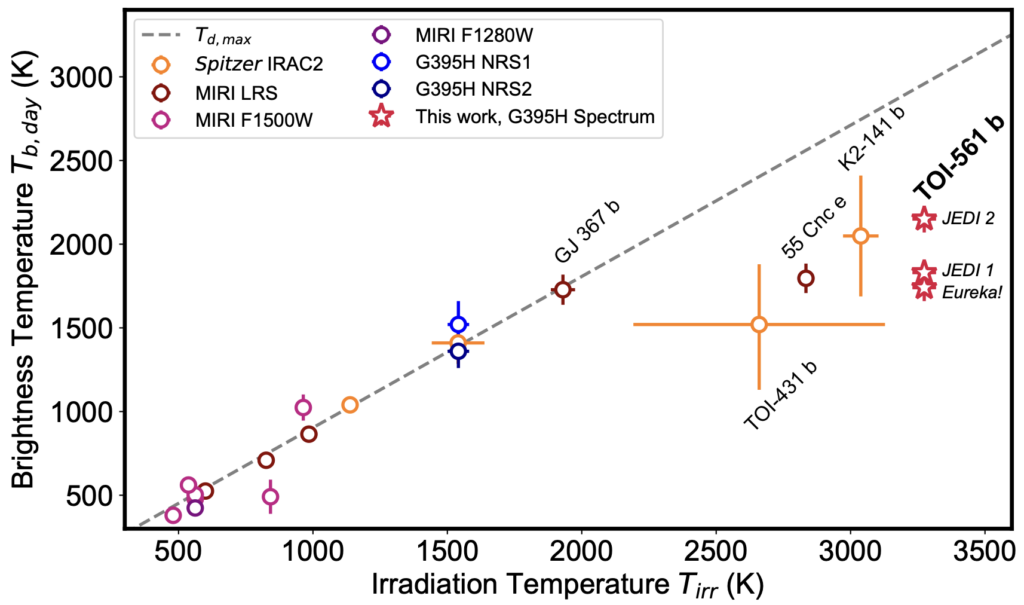
When comparing the observed temperatures of several rocky exoplanets to these expectations (see Figure 2), most follow the predicted trend, consistent with bare, atmosphere-free surfaces. However, TOI-561 b’s dayside is significantly cooler than expected for a stripped, rocky world, providing strong evidence that something is moderating the planet’s temperature.
Combined with its low bulk density, the most plausible explanation is the presence of a substantial, volatile-rich atmosphere, capable of redistributing heat from the dayside to the nightside via atmospheric circulation and preventing the extreme temperatures expected for a bare surface. In this sense, TOI-561 b appears to defy the typical Icarian fate of losing its “wings”: instead of being stripped bare, it has managed to retain its atmosphere, even under the intense heat of its host star.
TOI-561 b might not be the only one to defy its Icarian fate: Figure 2 shows that several other exoplanets, with temperatures exceeding 2000 K, also appear cooler than expected. This is especially reassuring for future USP exoplanet observations, as it supports the theory that vast lava oceans on these worlds could serve as reservoirs for volatiles, replenishing and maintaining their atmospheres over time.
Stay tuned, Icarian dreamers!
For now, TOI-561 b’s dayside emission spectrum hints at a thick, heat-shielding atmosphere, but the full tale awaits future chapters. As astronomers continue to unravel the secrets of other extreme rocky worlds, we may one day rewrite the astronomical myths themselves, telling tales of exoplanets that dared to “fly” too close to their stars and yet held onto their wings.
Astrobite edited by Ryan White
Featured image credit: Artistic impression of an ultrahot super-Earth, orbiting very close to its star, credited to ESA/Hubble/M. Kornmesser, licensed under CC BY 4.0.
