
Authors: Eun-jin Shin, Matthew C. Smith, Debora Sijacki, Martin A. Bourne, Sophie Koudmani
First Author’s Institution: Institute of Astronomy, University of Cambridge, Cambridge, United Kingdom
Status: submitted to Monthly Notices of the Royal Astronomical Society [open access]
Big Black Holes
Astronomers believe that a massive black hole resides in the center of nearly every known galaxy. This is also often (but not always) true for dwarf galaxies – smaller galaxies that often orbit larger ones. For example, the Milky Way has dozens of known satellite dwarf galaxies. A massive black hole in the center of a (dwarf) galaxy controls the motions of bodies in the central region. These black holes grow by accreting surrounding material and merging with other black holes. However, stars produce feedback by emitting particles (called stellar winds) and light that can clear out nearby gas, making it more difficult for black holes to accrete. This effect becomes even more pronounced for supernovae – massive stellar explosions that outshine entire galaxies! These explosions also disturb gas in the vicinity and inhibit black hole accretion. Today’s authors use high-resolution simulations of dwarf galaxies to study how these stellar feedback processes impact massive black hole accretion.
Simulating Dwarf Galaxies
The authors run two sets of four simulations. The first set tests different feedback mechanisms:
- The “noFB” simulation does not model any stellar feedback.
- The “PIPE” simulation models two types of feedback from massive stars. The first is photoionization (PI), where photons ionize atoms and molecules. The second is photoelectric heating (PE), where electrons are removed from dust grains and collide with gas particles, causing the gas to heat up.
- The “SN” simulation models feedback from supernovae.
- The “full” simulation combines the feedback processes from the PIPE and SN simulations.
The second set of simulations uses the full feedback prescription and tests different criteria for star formation. Different models of star formation can lead to different star formation rates (SFRs), and the SFR gas significant implications for the importance of these different feedback mechanisms (more stars mean more feedback). The authors consider models that vary some aspect of star formation:
- The “fixed-SFthr” model uses a fixed star formation threshold for forming stars rather than one that depends on the local environment.
- The “SFeff100” model assumes perfect star formation efficiency (100%) instead of the nominal value of 2%. When a region of gas becomes dense enough to form a star, this value determines how much of that gas goes into the star itself.
- The “1/2soft” model halves the gas softening length. Since the gravitational force scales as 1/r2, this can produce unrealistically large gravitational forces in the simulation when particles come very close to each other. The softening length “smooths out” the gravitational force across this distance when the separation between particles becomes very small. However, this length impacts the scales on which structures (such as star clusters) form.
- The “lowZ” model reduces the gas metallicity (the mass abundance of elements heavier than helium) by a factor of 10. The metallicity determines how quickly clouds of hot gas are able to cool and collapse to form stars. Additionally, a lower metallicity better resembles conditions in the early universe, providing insight on early galaxies as well.
To Feed or Not to Feed
The authors first look at visualizations of the dwarf galaxy and its central region in the different simulations, shown in Figure 1. Without feedback, there are clear filamentary structures and high-density clumps of star formation corresponding to locations with low temperatures and little ionization. With stellar feedback, this gas is more diffuse but not much hotter or more ionized. With supernova feedback, the central region is almost completely devoid of gas, meaning that there are basically no stars, and any remaining gas is hot and ionized. When both stellar and supernova feedback are in play, their competing effects partially cancel out. There are still filaments with high-density, cool, low-ionization clumps of star formation, as well as low-density, hot, highly-ionized regions heated by supernova feedback.
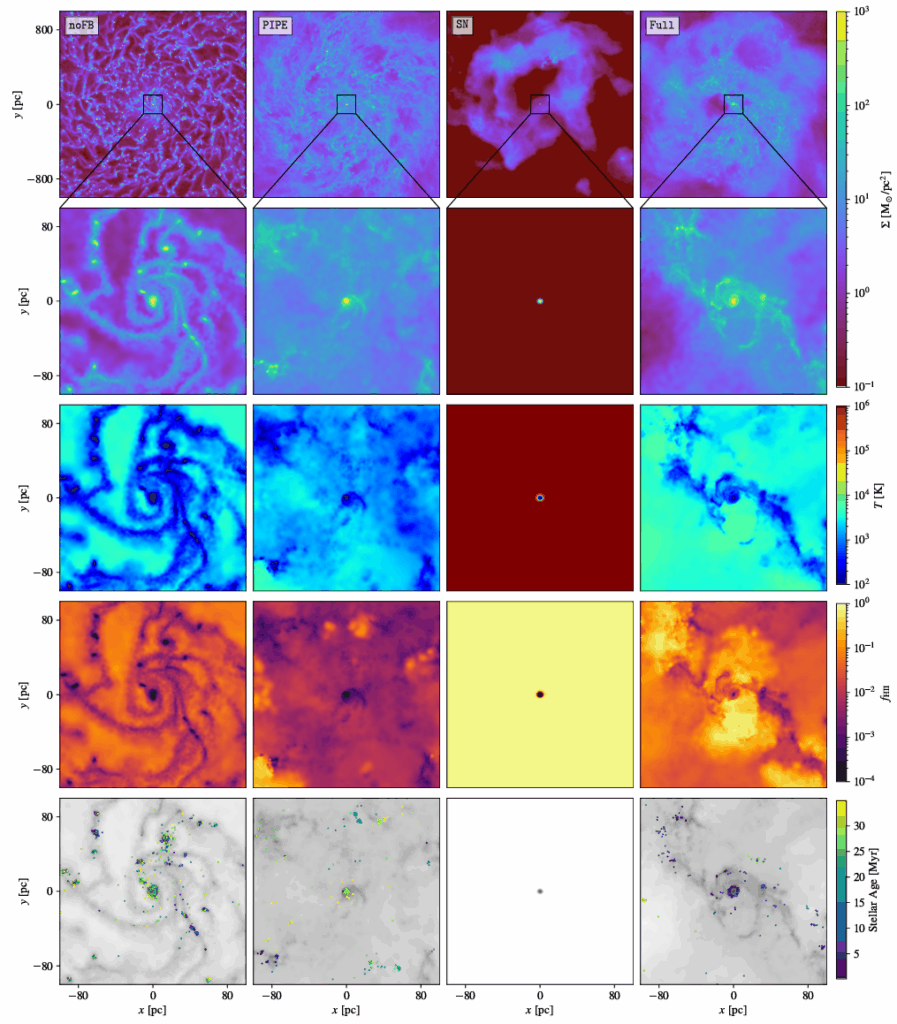
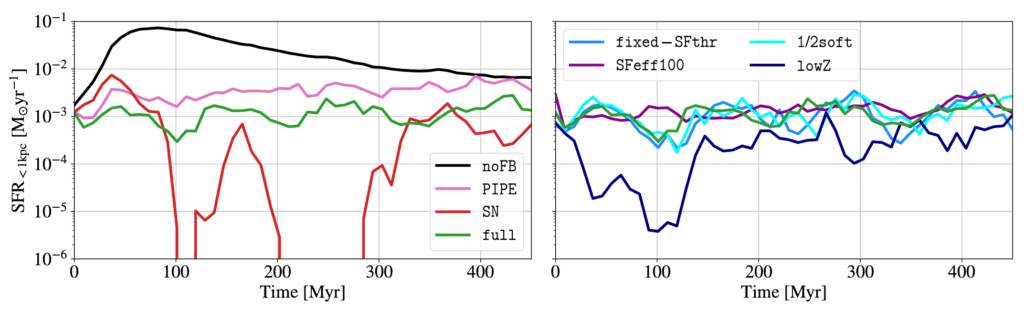
Figure 2 shows the star formation rates of the simulations with different feedback mechanisms and different criteria for star formation. The simulation without any feedback consistently has the highest SFR. Star formation is significantly more sporadic when supernova feedback is incorporated, but this is largely mitigated when stellar feedback is added, leading to a fairly stable SFR. This is because stellar feedback regulates further star formation (which leads to eventual supernovae) by heating up the gas, making it more difficult for gas to cool and collapse to form more stars. The simulations testing different star formation criteria exhibit similarly steady SFRs, highlighting that the results are robust to different star formation models, with the only major outlier being the simulation with lower metallicity tending to have a lower SFR. This is because lower metallicity also makes it more difficult for gas clouds to cool and collapse to form stars.
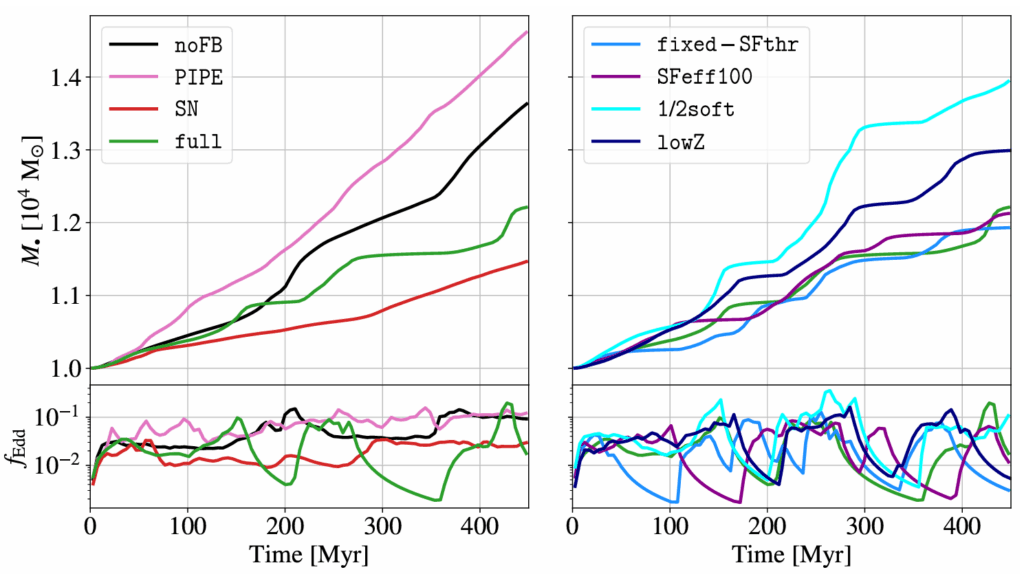
The authors then consider the growth of the central massive black hole, shown in Figure 3. Relative to the run without feedback, stellar feedback actually increases the growth of the black hole. Growth is substantially inhibited with supernova feedback due to major disruptions to the gas supply that the black hole accretes from. These effects partially cancel when both feedback types are considered, through there is less overall growth than without feedback. This is consistent with results found by other researchers. Reducing the gas softening length leads to a notable increase in black hole growth because it increases the density of material in the accretion disk around the black hole, meaning that the black hole can accrete more material. Lowering the metallicity also increases black hole growth because this inhibits the formation of stars, leaving more gas available to accrete. Other star formation criteria do not have a significant impact on black hole growth.
In summary, these different feedback mechanisms have a noticeable effect on the growth of massive black holes in galaxies, which has implications for massive black holes growing in similarly-sized galaxies in the early universe. Combined feedback from stars and supernovae tends to reduce the growth of the central black hole, leading to more diffuse but patchy regions of gas available to form stars. Different prescriptions for star formation do not yield significant changes in these results, highlighting that the results are robust to different models of star formation. The authors note that future work can build upon this by:
- including feedback from the massive black hole itself, which also plays a major role in disrupting the gas supply;
- accounting for magnetic fields, which can influence the formation of stars; and
- simulating multiple neighboring dwarf galaxies to allow for interactions between them.
Astrobite edited by Will Golay
Featured image credit: Caltech / Phil Hopkins group
