
Title: Neutrino Flavor Transformation in Neutron Star Mergers
Authors: Yi Qiu, David Radice, Sherwood Richers, Maitraya Bhattacharyya
First author’s institution: Institute for Gravitation and the Cosmos, The Pennsylvania State University, University Park PA 16802, USA
Status: Published in Physical Review Letters [closed access]
Neutron stars pack the mass of a star into the size of a city. If you’ve ever walked the length of Manhattan, you’ve walked the diameter of an average neutron star. They form from the leftover cores of 8 – 20 solar mass stars that die in violent supernova explosions. Neutron stars don’t do anything halfway: they rotate extremely fast, host extremely strong magnetic fields, and contain extremely exotic matter. They are one of several end states of stellar evolution, meaning studying their occurrence and properties can tell us something about the history of stars in our Galaxy.
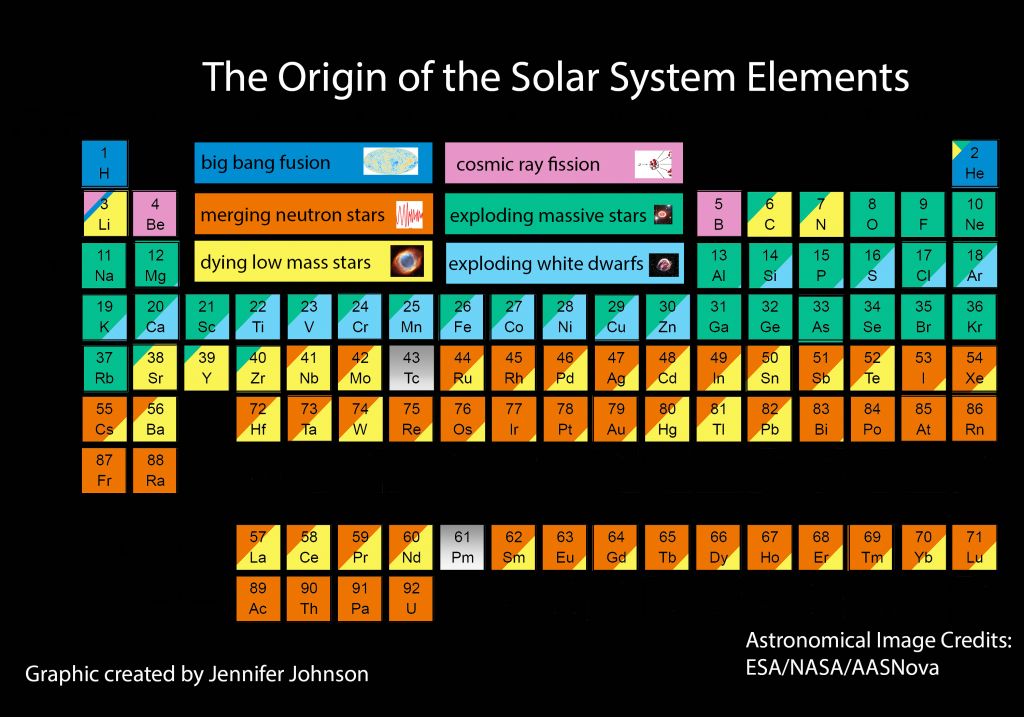
Neutron stars sometimes come in pairs, comprising binary neutron star systems. These systems happily orbit, until, eventually, they don’t. As they orbit, they lose energy due to the emission of gravitational waves (check out the Astrobites Guide to Gravitational Waves), whose existence was predicted by Einstein. The experimental search for the gravitational waves began in the 1960’s, but there were no robust detections until 2015 with the advent of LIGO/Virgo/KAGRA. LIGO has now detected a couple signals associated with neutron stars merging together. These violent mergers are thought to be major contributors to the production of heavy elements, as shown in Figure 1.
Simulating the merger of two neutron stars is a daunting task, as such an exotic event involves physics we often ignore. Neutrinos are fundamental particles with very little mass that typically do not interact much, but they matter in the dense environments of these mergers. They come in three flavors (electron, muon, tau), and a variety of proposed and confirmed processes can result in the transformation of a neutrino from one flavor to another. Today’s paper investigates the implications of neutrino flavor transformation on neutron star mergers, looking into how they affect the postmerger remnant and the synthesis of heavy elements.
The authors of today’s paper set up a simulation with two non-rotating 1.35 solar mass neutron stars initially separated by 45 km. They vary the extent of neutrino mixing, which affects whether flavor transformations occur. No mixing = no flavor transformations. There is no neutrino mixing in one simulation, while the other two include various mixing models.
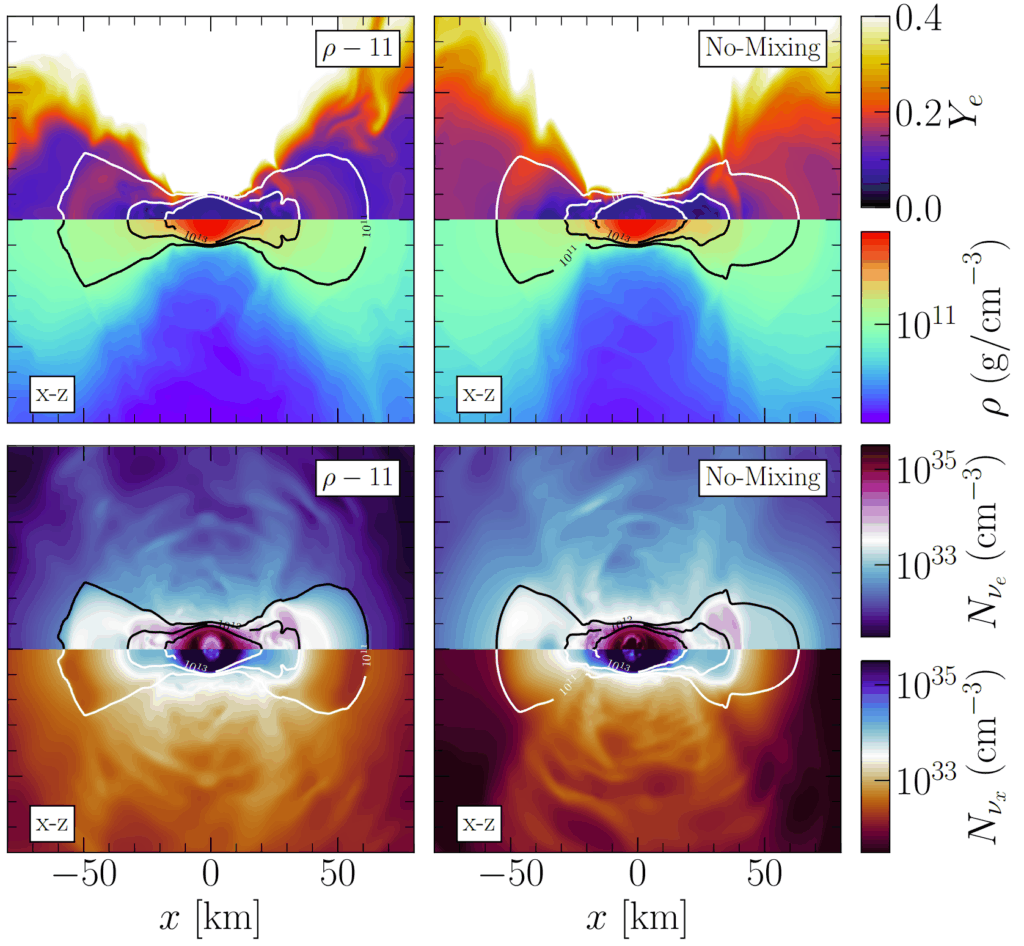
The merger occurs ~15 ms after the start of the simulation. Figure 2 shows a snapshot of the system ~15 ms post-merger, where we can look at various properties of the resulting disk. It is a really complicated plot, but direct your eyes to the top, where you can see the electron fraction Ye differs between the no-mixing and mixing simulations. Neutron-rich material has a low Ye value, and we can see neutrino flavor transformations result in more neutron-rich material ejected from the system. The bottom row shows the number densities of electron neutrinos (top half) and other flavor neutrinos (bottom half). This result shows neutrino flavor transformations result in a net transformation of electron neutrinos to other flavor neutrinos.
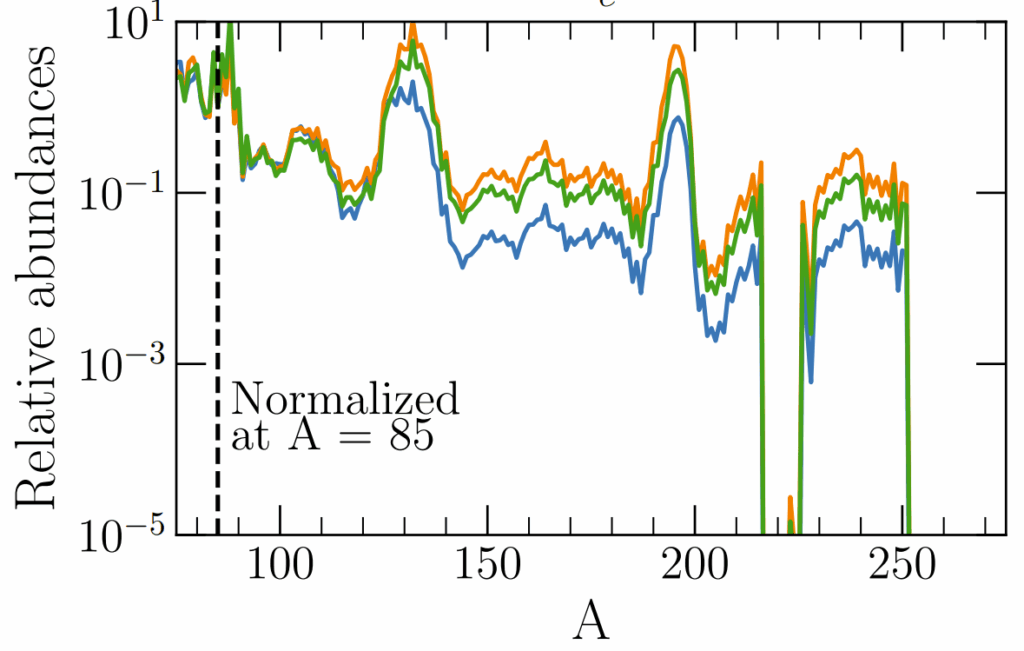
So what implications do these novel simulations have? First of all, simulating neutrino flavor transformations results in more neutron-rich ejecta. This material better facilitates r-process nucleosynthesis in which heavy elements are created via rapid neutron capture. Figure 3 shows that neutrino flavor transformations increase the yield of heavy element synthesis, especially for elements with mass number A > 120. Secondly, the authors also simulate what the gravitational wave signature of the post-merger remnant could look like. They find that neutrino flavor transformations would result in the remnant being brighter in gravitational waves and possibly observable with future gravitational wave detectors.
So, neutrino flavor transformations might seem like relatively esoteric physics. However, they have real implications for neutron star mergers, among the most violent and extreme phenomena in our universe. This paper is a really exciting proof of concept showing that neutrino flavor transformations leave an imprint on nucleosynthesis and gravitational wave signals. Neutron stars are an end state of stellar evolution, but it turns out stars can be quite active in their death.
Astrobite edited by Jessie Thwaites
Featured Image Credit: Sonoma State Univ./A. Simonnet; NASA
