
Title: Retrieving the Red Edge on Earth-like Planets with Heterogeneous Clouds and Surfaces
Authors: Zachary Burr, Mario Damiano, Vincent Kofman, Renyu Hu and Geronimo L. Villanueva
First Author’s Institution: ETH Zurich, Institute for Particle Physics & Astrophysics, Wolfgang-Pauli-Str. 27, 8093 Zurich, Switzerland
Status: accepted to The Astrophysical Journal [open access]
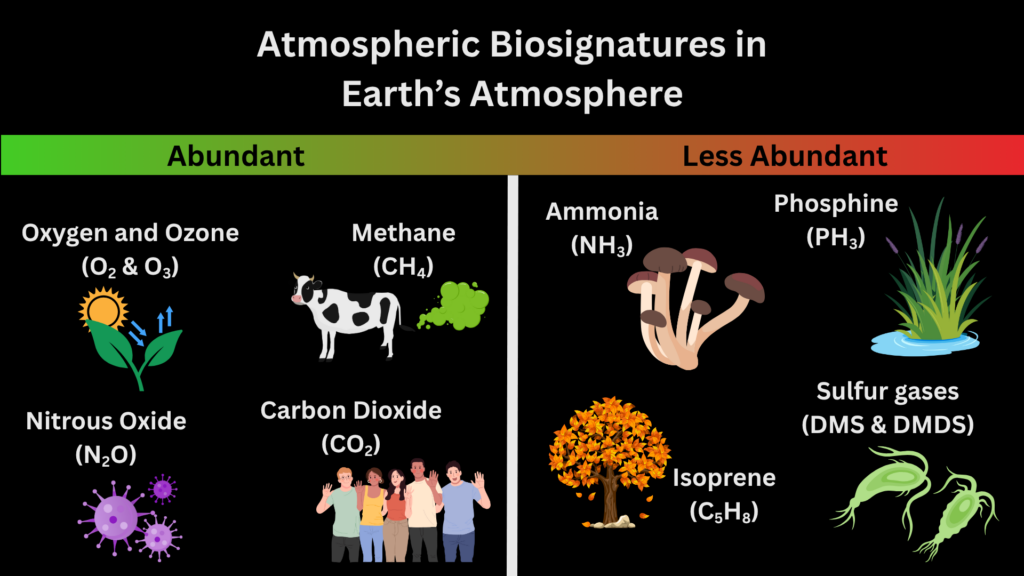
In the next 25 years, astronomers could find signs of life on other planets with the launch of the Habitable Worlds Observatory. Atmospheric signs of life, known as atmospheric biosignatures, are how astronomers currently search for life on other planets. Figure 1 shows examples of these with pictures of each chemical’s origin. Before E.T. can phone home though, we have to understand what chemicals make up a planet’s atmosphere. To do this, astronomers can use spectroscopy to observe the atmosphere in different wavelengths and measure the types and quantities of chemicals present. There are many ways to observe the spectrum of a planet but the one you’re probably most familiar with is transmission spectroscopy. You can learn more about transmission spectroscopy of exoplanet atmospheres and how to model them with these bites: 1, 2, 3. However, all of the current techniques for exoplanet spectroscopy (including transmission spectroscopy) measure the star’s light and how the planet affects the star’s light. This means it’s heavily dependent on how we model the star’s light to indirectly observe the planet’s light. The only way to directly take spectroscopy of a planet is with direct imaging: the technique that the future Habitable Worlds Observatory will use to find signs of life in planetary spectra.
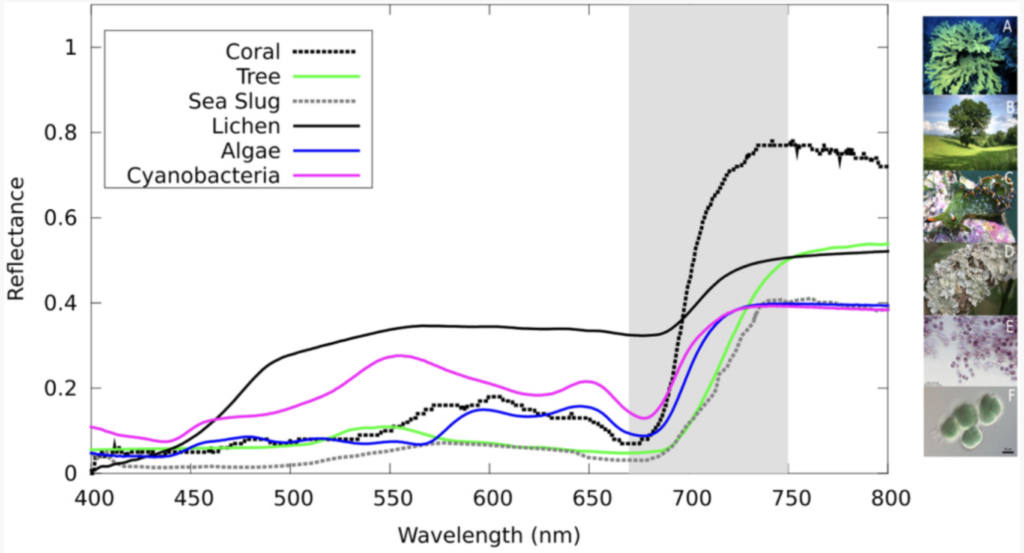
But are atmospheric biosignatures the only way to tell if life exists on other planets? Short answer: absolutely not. Let’s take Earth for example. If we imagine Earth as a directly imaged exoplanet and take spectra of its atmosphere, you’ll find that at around near-infrared wavelengths (~700 nanometers or just past the red part of the visible light spectrum), the reflected light off of Earth’s atmosphere increases sharply. This sharp increase is called the vegetation red edge (VRE) and is caused by plant and ocean life on Earth’s surface as shown in Figure 2. This is made possible because chlorophyll (the thing that makes plants green) absorbs nearly all visible light but reflects near-infrared light. The VRE is an example of a surface biosignature. In today’s paper, the authors determine if the VRE will be visible in spectra of Earth-like exoplanets!
Snapshots
Planets rotate; that’s how we have morning, noon and night in 24 hours guaranteed. This means that different parts of the surface will be visible at different times when we take spectra. Sometimes, we may see more ocean than land, other times not. To determine if the VRE would be visible at all points in Earth’s day, the authors simulated 9 different spectra of modern-day Earth representing 9 snapshots of Earth’s orbit. Additionally, they also simulated a time-averaged spectra: that is, if we instead see all of Earth’s day in one snapshot without the time variability. These spectra are shown in Figure 3.
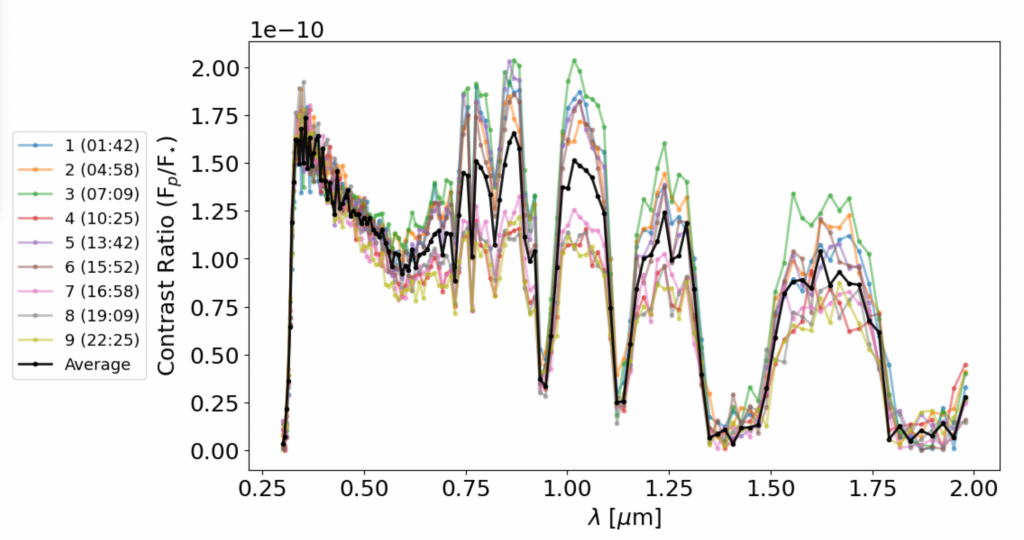
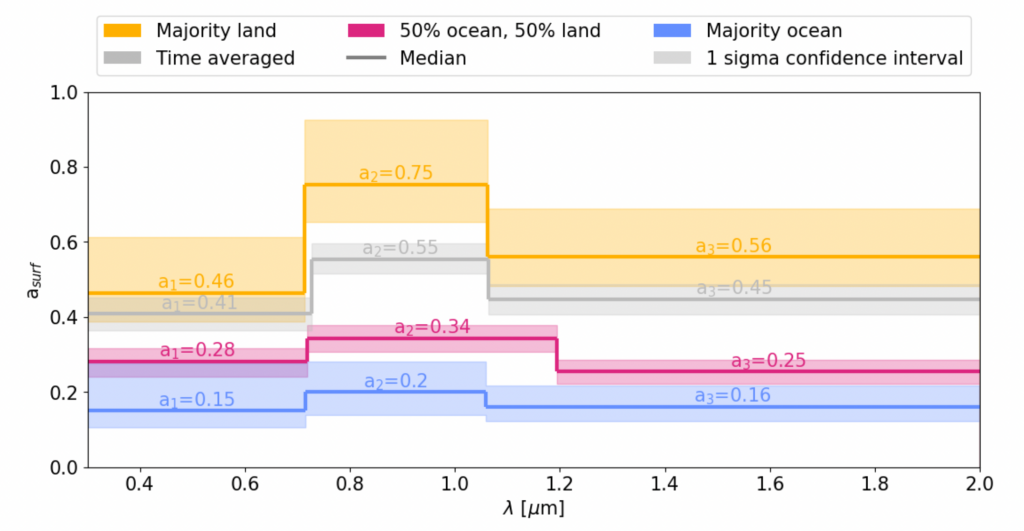
The authors then run retrieval models on all 9 spectra to see if the VRE would be detectable in each spectrum, including the time-averaged one. Retrieval models take into account characteristics of the planet that would affect how light moves through their atmospheres, such as the atmospheric chemicals present and surface gravity. They then use this information to generate possible spectra models that could fit the data. The best-fit model allows astronomers to infer what the atmosphere is made up of and properties of the planet such as surface gravity. Because we are looking at Earth in visible light, much of the light from the planet is reflected. Typically, models of Earth-like planets in visible wavelengths only include atmospheric albedo: the measure of how reflective a planet’s atmosphere is. However, surface biosignatures can also be reflective as shown by the VRE. The authors use this to their advantage and introduce a surface albedo into their model that changes with the amount of desert, vegetation and ocean that are visible on Earth’s surface at that time. They then further divide the 9 spectra into three different types based upon the visible surface: majority land, 50% land, 50% ocean, and majority ocean. Check out the paper online to see a cool animation of the Earth rotating and how the spectra looks different at each time!
Arr! There be…vegetables?
After running the models, the authors were able to detect a sharp increase in their surface albedo value in every spectrum: including the time-averaged one. This result is shown in Figure 4. The authors take this result one step further in order to validate that the VRE is actually a result of surface variation of vegetation. They re-run models on each of their spectra, but instead include a constant surface albedo instead of a time-varying one. This resulted in incorrectly measured radii, chemicals, and surface gravity in nearly all of the models. Without the VRE and surface features, the models could not accurately determine if life was present on Earth.
For the first time (to the author’s knowledge), the VRE has been shown to be a promising and observable biosignature in Earth-like atmospheres. This study has also laid the groundwork for future work on other surface biosignatures and their potential impact on spectra of habitable planets. Confirming signs of life in multiple different ways, both on the surface and in the atmosphere, will finally allow astronomers to say we are not alone in the Universe. In fact, life likes to live on the (red) edge!
Astrobite edited by Madison VanWyngarden
Featured image credit: [Ph03nix1986]

![[Ph03nix1986]](https://commons.wikimedia.org/wiki/File:PlanetaSH(3).jpg)