
Title: The illusion of morphology in tidal structures: changes to stellar shells and streams in non-spherical haloes
Authors: Smrithi Gireesh Babu, Viraj Ekanayaka, William H. Oliver, and Geraint F. Lewis
First Author’s Institution: Sydney Institute for Astronomy, School of Physics A28, The University of Sydney, NSW 2006, Australia
Status: Published in Monthly Notices of the Royal Astronomical Society [open access]
Galaxies are anything but static. Gas and dust within any particular galaxy orbits around the galactic centre, often creating stars that continue to orbit within a relatively flat disc. This is not the only source of stars within a galaxy, though; galaxies within cluttered environments tend to gravitationally interact and merge with each other, integrating the stellar populations in the process. The most dramatic examples of this are in the mergers of equal size galaxies, but all the more common are the tidal disruptions of satellite galaxies as they fall into a much larger host.
The dynamical outcome of these mass-imbalanced mergers depends largely on the initial trajectory of the infalling satellite. If the motion is mostly radial (that is, if the satellite is in the fast lane to the centre of the galaxy) then it will most likely create a ‘shell’ when it comes out the other side. In contrast, if the satellite is happily traipsing along the periphery of the galaxy then it will gradually extend tidal tails both in front of and behind it. Both the Milky Way and other galaxies have such tidal streams.
The final result of these mergers is not dictated solely by the initial trajectory though; today’s authors investigate how the shape of the gravitational well can influence the tidal distortion of the satellites. They begin at a potential similar to that of our very own Milky Way, running multiple models while varying the prolateness – how stretched along the z-axis a sphere is – of the enveloping dark matter halo. By seeing how this changes the shape of the tidal structures, astronomers may eventually be able to better understand the role of dark matter halo geometry in driving galaxy mergers.
The authors consider three different simulations of halo geometries. They consider a spherical dark matter halo (a horizontal-to-vertical axis ratio of q=1) as a baseline with which to compare a strongly oblate (q=0.5 – i.e. the spheroid is twice as wide as it is tall) and strongly prolate (q=1.5 – an extra half as tall as it is wide) halo to. In each of these halo geometries they then integrate the motion of three satellite galaxies (or ‘subhaloes’): one on an almost radial orbit, one on a highly elliptical orbit, and finally an intermediate case on a trajectory between the two others. The outcome of evolving these systems for 8.6 billion years – long enough for tidal structure to have formed in any scenario – is shown in Figure 1.
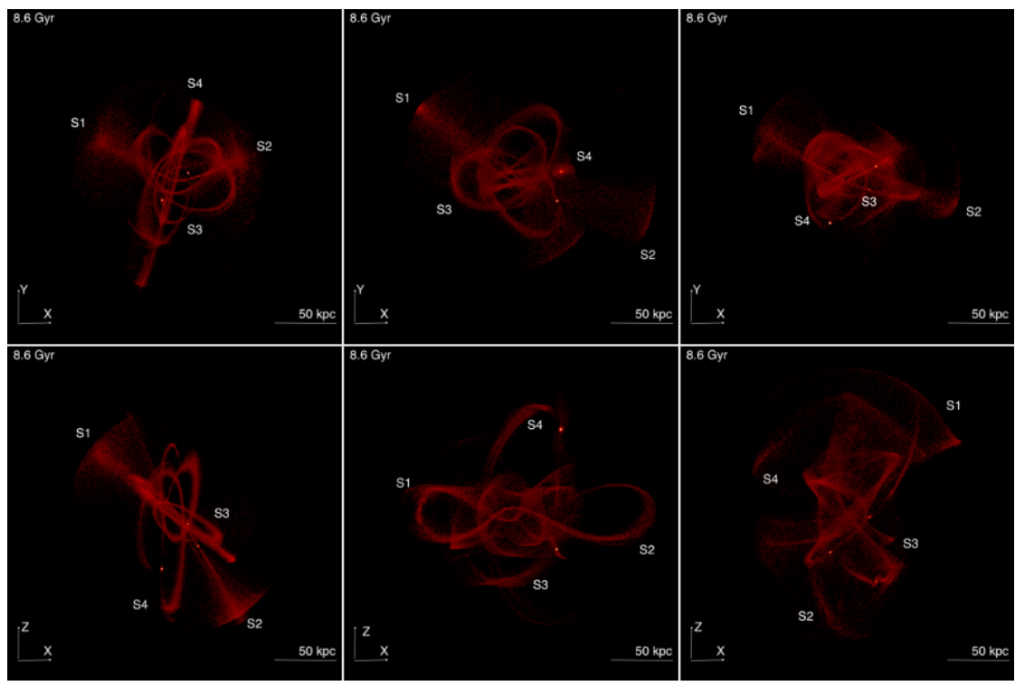
Figure 1: The tidal structure formed over 8.6 Gyr in each of the three simulations is shown here, where each column shows a different simulation (left to right: q=1, q=0.5, q=1.5) and each row is a different view (top row: ‘face on’; bottom row: ‘edge on’). The authors identify significant structures that have formed: ‘S1’ and ‘S2’ are formed from the radial subhalo, ‘S3’ from the elliptical subhalo, and ‘S4’ from the intermediate subhalo. Source: Figure 1 in today’s paper.
Visual inspection of the features in Figure 1 shows clear distinction between the ‘flattened’ shells and streaking streams in many cases (e.g. ‘S1’ and ‘S4’ respectively in the left most column), though many features are ambiguous when viewed from different angles. Because of this viewing angle degeneracy, the authors look into other ways of identifying structure. What has often been used in the past is to look at the energy and momentum of an identified structure, which allows you to distinguish between shells and streams since these structures typically occupy different energy-momentum combinations. Today’s authors go a step further and use a novel, 6 dimensional clustering algorithm called AstroLink to identify stream and shell structures in their simulations. One depiction of the output of the algorithm – showing how streams and shells can differ – is shown in Figure 2.
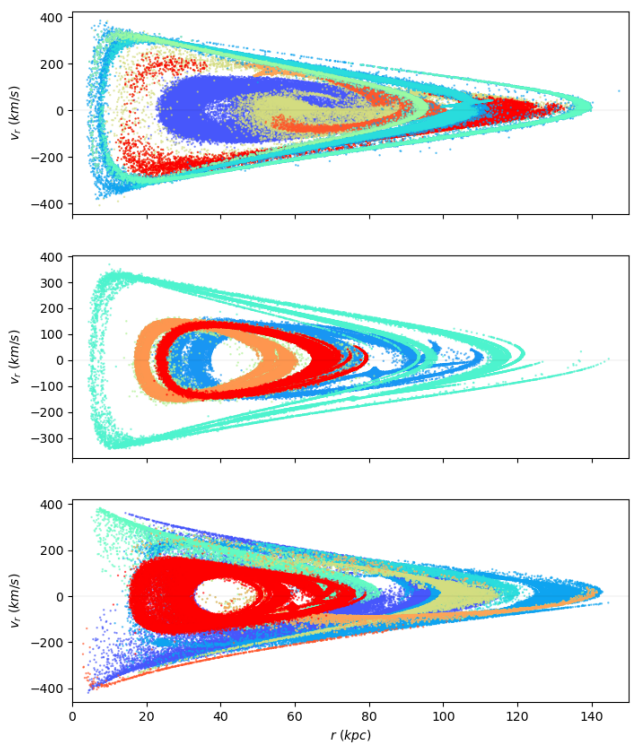
Figure 2: The distinct features, identified by the AstroLink algorithm, occupy different regions of the radial velocity versus radius parameter space. Each point is coloured according to its corresponding feature, where the ‘S1’ and ‘S2’ shells are turquoise, the ‘S3’ stream is the red and orange points, and the ‘S4’ stream is the blue points. The panels, top down, are for the q=0.5, q=1, and q=1.5 simulations. Source: Figure 4 in today’s paper.
Since the initial conditions of the subhaloes are consistent across simulations, Figure 2 shows how the time-evolved dynamics are sensitive to the shape of the broader galaxy potential geometry. Though this potential-dependence has so far been shown on simulated data with a wealth of information (e.g. the positions of particles in 3D space), the authors are looking into how to discern halo geometries on more limited data (for example limiting the clustering to the angular positions of particles like what real observations might depict). As state-of-the-art observations from the Vera C. Rubin Observatory and Nancy Grace Roman Space Telescope begin to flood in, analyses similar to this may help to reveal the shape of dark matter in our Universe’s galaxies.
Astrobite edited by Jayde Willingham
Featured image credit: SDSS/PanSTARRS-1/Giuseppe Donatiello

