
This interview is part of Astrobites coverage of #BlackSpaceWeek presented by Black in Astro. Black in Astro is a grassroots organization that offers support and networking for Black people working in or studying astronomy and space-related fields across the globe. Black Space Week is a virtual conference that features panels, talks, art, giveaways, and various other virtual events to celebrate Blackness in astronomy and space science. For more information on Black Space Week and Black in Astro, please visit their website: https://www.blackinastro.com/.
Today’s interviewee is Flore Milien, a first-year doctoral student at Chalmers University of Technology.
Through the Lens of an Observer
When presented with the choice of a telescope or a microscope for Christmas one year, Flore Milien chose a telescope…and a career in astronomy. Nobody in her family had pursued science before, so she drew her inspiration from documentaries instead. From a young age, she watched documentaries on stars and galaxies, and grew up with a love for both. “I would often go to the library to find books about astronomy and watch YouTube videos on astronomy. I was very attracted to the idea of space and the unknown.”
Galaxies have always been something that interested Flore. She first pursued galaxy research during her undergraduate studies at Sorbonne University, where she used radio observations to build the Milky Way’s rotation curve and map the location of our spiral arms. Rotation curves of galaxies show how fast a galaxy is spinning at different distances from the galactic center and can be used to map the amount of mass at each of these distances (and dark matter!). Flore expanded her galactic research during an internship in her master’s studies to other galaxies, using simulated data to study galaxy pairs and mergers. However, she found that working with observations was where she really wanted to be.
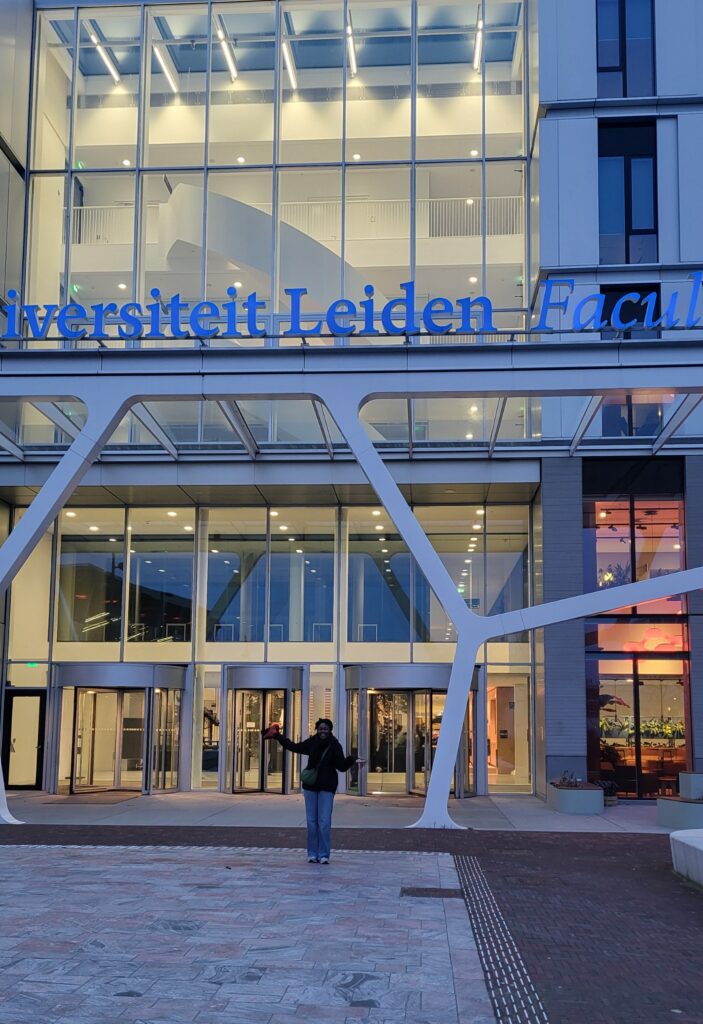
“Observations feel a little bit more real to me. I like working with data of galaxies that I can ‘see’.” Flore’s current work uses observational data to understand how the environment surrounding a galaxy affects its evolution. Specifically, she looks at galaxies with buddies (companion galaxies) and the impact that galaxy-galaxy interactions have in cosmic noon environments (~10-12 billion years ago when star formation was at its highest in the universe). “If we observe the environment of galaxies and then we see that these galaxies have companions, we can search for evidence that there have been past interactions such as potential mergers orother kinds of interactions between the galaxy and its companion galaxies.”
Finding Community
While her love for galaxies never really stopped, the transition into undergraduate and academia was tough and at times, made her question her love for astronomy. Flore grew up in the suburbs of Paris, France but when she attended her undergraduate university in the city, she felt like she didn’t belong. “It’s something I noticed right away when I came to university, I was often the only Black person in any of my classes. It was complicated to navigate.”
The United States has nationally-recognized organizations that emphasize the Black experience and offer professional ways of community building, such as Black in Astro and the National Society of Black Physicists. However, in Europe, these opportunities and organizations do not exist. Additionally, there aren’t many Black professors at Flore’s universities, making the process of finding a mentor she can relate to difficult. Due to these factors, community is challenging to find and build, so many other Black students have to navigate academia by themselves. Flore mentioned that while gender equality is something European academia has progressed on, race is not something brought up in these discussions. “I am a woman, but I am also Black. I think there is still work to be done taking into account everyone’s identity.”
Despite difficulties in navigating academia, Flore has forged her own path and built a community of her own with people she can count on. “I’ve found people that I can study with on a deadline, have lunch with, laugh with but also talk about the struggles of being Black in academia with.” She also cited her love for her current research and her mentor as reasons she’ll be continuing in academia. “I have a great project and great advisor, and it’s made me want to stay in academia for the time-being and pursue a postdoctoral research position after my PhD.” Outside of work, Flore enjoys being creative through photography, painting, drawing and sketching. She has also taken up dancing again. “I danced for a couple of years when I was younger, modern jazz and a bit of hip hop. I stopped for a few years but started hip hop dancing again this year.”
Advice for young Black scientists
When asked for any advice she had for young Black scientists, Flore answered,“Do not give up, even when classes get difficult, keep working at it. Even if most people in the room don’t look like you, don’t let that discourage you from continuing in the field.”
Edited by Nathalie Korhonen Cuestas
Featured image credit Flore Milien
