
Title: A framework for evaluating biosignature potential against the abiotic baseline on ocean worlds
Authors: Peter M. Higgins, Weibin Chen, Oliver Warr, Lucas M. Fifer, Wanying Kang, Charles S. Cockell & Barbara Sherwood Lollar
First author’s institution: Department of Earth and Planetary Sciences, Harvard University, Cambridge, MA, USA
Status: Published in Nature Astronomy [closed access]
What if we found life on a moon in our Solar System? Not on a planet, but in a hidden ocean beneath miles of ice.
We think Solar System moons could have life because they have the basic ingredients life needs: liquid water, energy, and the right chemistry. Europa and Enceladus each have a water ocean underneath a lid of ice. The tidal heating from the planet they orbit warms up the interior of the planet, preventing the water from freezing. Titan, meanwhile, has lakes of methane instead of water. That these moons have life has been suggested before.
But even if life was on one of these moons, how would we find it? One option is that we directly find aliens moving and squirming around on one of these solar system moons. More likely, we would see signs of life and then conclude that there are aliens on that moon.
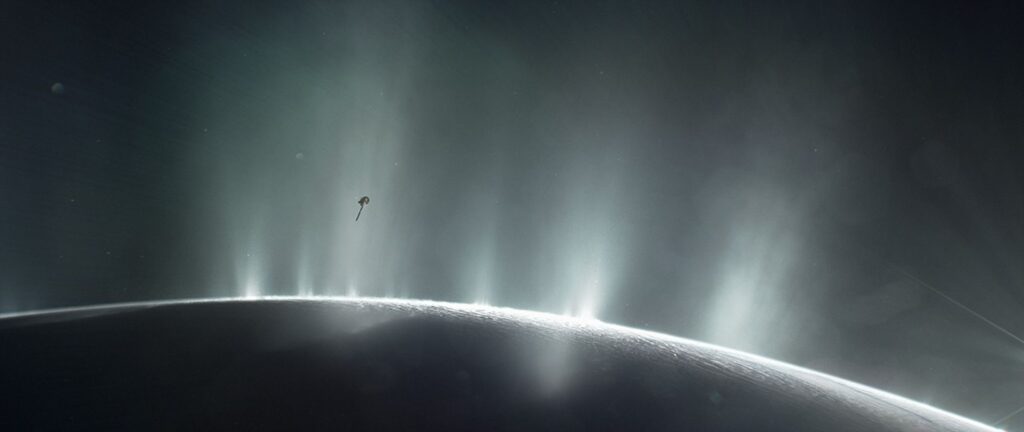
Figure 1: An image taken by Cassini of the water plumes on Enceladus, a moon that orbits Saturn. Image credit: NASA
What could those signs of life even be? Even though it’s hard for us to visit these moons, we can observe them from Earth and we have also flown by them in the past. This mission, Cassini, even flew through an ocean water geyser on Enceladus to see what measurements it found (see Figure 1). With this kind of data, we can look for biosignatures: clues that don’t prove life is there, but are hard to explain without it.
One easy measurement is what gases exist on that moon. For instance, methane and CO2 on Earth are constantly being produced and consumed by living beings. However, both these gases are also produced by abiotic processes, or processes that aren’t life. For instance, CO2 can be emitted by volcanoes on Earth. If we find too many of these gases, though, in numbers that cannot be explained by chemistry and geology, that can hint that something (or someone…) might be making them.
We can also measure ratios of the same element at different weights, or isotopes. Life tends to prefer using the lighter, easier-to-process isotopes, so detecting unusual isotope ratios on a moon can be a fingerprint that biology, and not just chemistry, was at work.
Finally, we can analyze the actual molecules present on these worlds. Many molecules, like amino acids necessary for life, come in two mirror-image versions, called “left-handed” and “right-handed.” This is known as chirality. Life, however, is picky; Earth life uses almost exclusively left-handed amino acids. That means that if we find a non-50/50 mix of amino acids, we know that something alive built it.
That said, we need to be able to quantify this weirdness. For instance, how much extra methane is “too much” to blame on geology alone? How skewed does an amino acid mix need to be before it’s biological and not a fluke of chemistry?
Today’s paper aims to do exactly that: build a framework to decide when something is genuinely life on one of these ocean moons and not an abiotic false alarm. They specifically use Enceladus as an example, and focus on the biosignatures of gases, isotopes, and amino acid chirality. They also focus on Enceladus because the amount of methane detected when Cassini flew through the ice plume was higher than expected, and some have suggested this is evidence for life.
Their aim was to build an abiotic model of Enceladus, and see how much life you would need to add to it in order to reliably distinguish it from geochemical processes.
For methane, they looked at all possible geochemical sources of methane and added it to their Enceladus model. When these processes had a range of possible amounts of methane produced, they used the maximal amount of methane created from only geochemical processes. They then compared this to how much methane may be created by microbes that breathe out methane.
For carbon isotopes, they looked at how the relative weight of carbon isotopes would change as gases move from the seafloor to the surface, through paths like ocean currents and the plumes of ice that spurt this carbon to the sky. All of these processes can also separate out the weights of carbon species, as gravity will preferentially keep heavier ones closer to the center of the planet.
Finally, for amino acids, the authors looked at how temperature and transit time through an ocean might make left-handed amino acids more common.
Figure 2: This figure demonstrates the authors’ tests of chirality and the likelihood of isotopic mixing ratios. Figure a on the left side demonstrates the chirality test The upper left image shows that chiral molecules are identical but mirror images of one another. The lower left image demonstrates how there are more left-handed chiral molecules in biology. Figure b in the upper right corner shows how the isotopic fraction of carbon in methane changes when biological carbon is produced. Figure c in the lower right corner demonstrates how temperature affects the chirality of amino acids. Image credit: Figure 1 from today’s paper.
In their results, this paper found that they couldn’t tell microbes making methane apart from entirely geochemical methane on Enceladus. For carbon isotopes, they saw again that they couldn’t tell carbon isotopes of life apart from geochemical processes. This means that for both these potential biosignatures, it would be almost impossible to tell if it was really biology or just bizarre geochemistry. If we did see these signals on Enceladus, we would risk making a false positive life detection.
Finally, for chirality, they found that any left-handed amino acids actually formed by life would be destroyed by chemistry in the oceans by the time we detect them. This is actually a false negative: we would assume that the lack of chirality means there is no life. Instead, there could be life whose chiral signature is being destroyed.
This might sound discouraging: it seems like there’s no way to detect life on these moons without physically collecting and analyzing a huge number of samples. But there’s a silver lining: if we understand the geochemistry better, we can detect biosignatures better. Right now, the “expected range” for things like methane levels and isotope ratios is huge, because we don’t yet know enough about the non-living chemistry happening inside these moons. If scientists can narrow down that range, then a measurement that falls outside it could potentially mean aliens. In other words, the path to detecting life isn’t just about building better instruments to fly through a geyser; it’s about understanding these moons well enough to know what “normal” looks like, so we can finally recognize what isn’t. And then maybe discover life.
Featured image credit: Shutterstock
Astrobite edited by Laurie Amen
