
Title: Photochemically produced SO2 in the atmosphere of WASP-39b
Authors: Shang-Min Tsai, Elspeth K. H. Lee, Diana Powell, Peter Gao, Xi Zhang, Julianne Moses, Eric Hébrard, Olivia Venot, Vivien Parmentier, Sean Jordan, Renyu Hu, Munazza K. Alam, Lili Alderson, Natalie M. Batalha, Jacob L. Bean, Björn Benneke, Carver J. Bierson, Ryan P. Brady, Ludmila Carone, Aarynn L. Carter, Katy L. Chubb, Julie Inglis, Jérémy Leconte, Michael Line, Mercedes López-Morales, Yamila Miguel, Karan Molaverdikhani, Zafar Rustamkulov, David K. Sing, Kevin B. Stevenson, Hannah R. Wakeford, Jeehyun Yang, Keshav Aggarwal, Robin Baeyens, Saugata Barat, Miguel de Val-Borro, Tansu Daylan, Jonathan J. Fortney, Kevin France, Jayesh M. Goyal, David Grant, James Kirk, Laura Kreidberg, Amy Louca, Sarah E. Moran, Sagnick Mukherjee, Evert Nasedkin, Kazumasa Ohno, Benjamin V. Rackham, Seth Redfield, Jake Taylor, Pascal Tremblin, Channon Visscher, Nicole L. Wallack, Luis Welbanks, Allison Youngblood, Eva-Maria Ahrer, Natasha E. Batalha, Patrick Behr, Zachory K. Berta-Thompson, Jasmina Blecic, S. L. Casewell, Ian J. M. Crossfield, Nicolas Crouzet, Patricio E. Cubillos, Leen Decin, Jean-Michel Désert, Adina D. Feinstein, Neale P. Gibson, Joseph Harrington, Kevin Heng, Thomas Henning, Eliza M.-R. Kempton, Jessica Krick, Pierre-Olivier Lagage, Monika Lendl, Joshua D. Lothringer, Megan Mansfield, N. J. Mayne, Thomas Mikal-Evans, Enric Palle, Everett Schlawin, Oliver Shorttle, Peter J. Wheatley, Sergei N. Yurchenko
First Author’s Institution: Atmospheric, Oceanic and Planetary Physics, Department of Physics, University of Oxford, Oxford, UK.
Status: Published in Nature [open access]
If you’re feeling off balance due to something outside of your control, it’s not a bad idea to take some time to relax and find your equilibrium once again. You might even try meditation or yoga. But if stress is always present in your life, being out of equilibrium may become your new normal. And that’s okay! Lots of people, and even planets, exist in a state of disequilibrium every day. Now, let us be mindful of one such example: the exoplanet WASP-39b, which is the focus of today’s paper.
Breathing In Imbalance
Before we begin, take a deep breath in… and a deep breath out. The air you just inhaled as part of this breathing exercise was mostly nitrogen and oxygen, along with trace amounts of other gases like argon, carbon dioxide, and methane. The atmosphere of Earth is a good example of an atmosphere that is not in chemical equilibrium. If given enough time, the oxygen in Earth’s atmosphere would react with all the methane to form carbon dioxide and water, until essentially no methane remained. And yet, we see oxygen and methane coexisting in ample supply! The composition of Earth’s atmosphere can be explained by biological processes, like trees and cows, which continuously replenish the atmosphere with more oxygen and methane before chemical equilibrium can be reached.
Just like Earth, the gas giant planet WASP-39b also has an atmosphere that is not in chemical equilibrium, but this time life isn’t to blame. Rather than having a temperate, oxygen-rich atmosphere like Earth, this hot-Jupiter-type exoplanet has a sweltering, high-pressure atmosphere with little oxygen and lots of hydrogen gas. I wouldn’t recommend trying any breathing exercises on this inhospitable planet!
An Atmospheric Reading of SO2
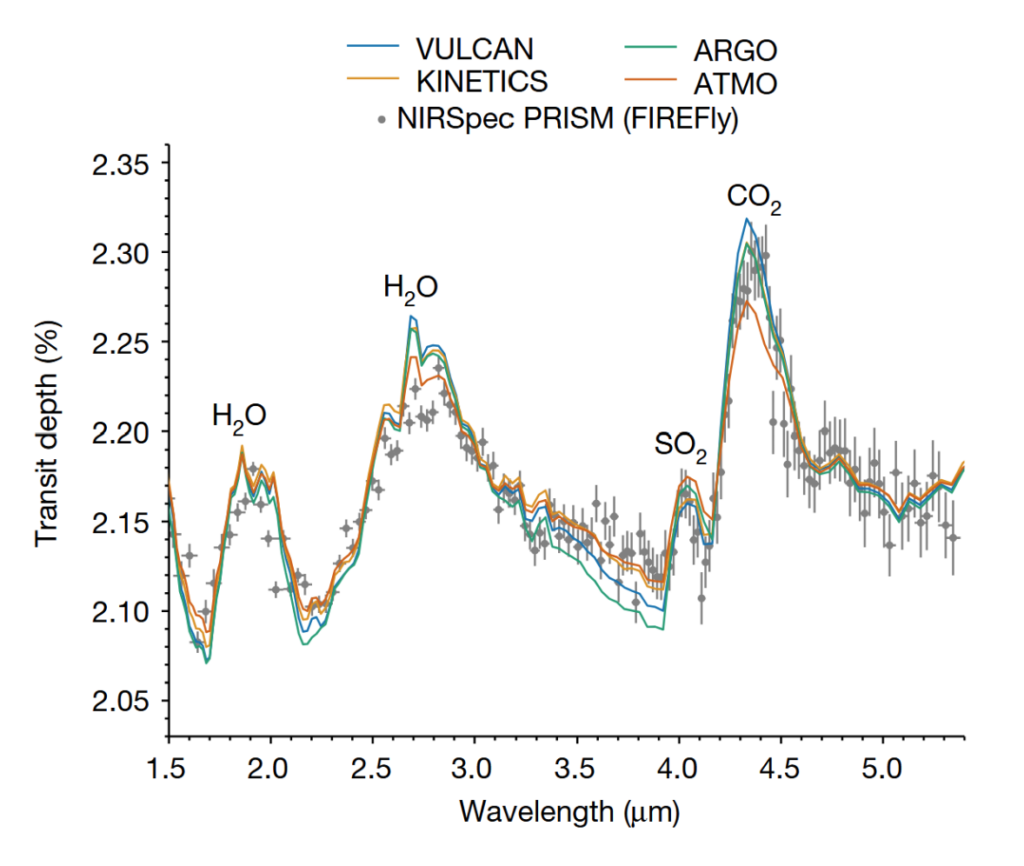
The mystery at the heart of today’s paper began when astronomers used the James Webb Space Telescope (JWST) to observe light passing through WASP-39b’s atmosphere using a technique called transmission spectroscopy. This technique can be used to identify specific kinds of molecules in an exoplanet’s atmosphere based on the specific wavelengths of light (or colours) that they absorb. Think of this like an aura colour reading… but for planets! (You reader, I sense, have a bright and cheerful yellow aura.) Following analysis, the transmission spectrum of WASP-39b revealed an unexpected result: the upper atmosphere of the planet contained sulfur dioxide gas (SO2). This is surprising because in a hydrogen-rich atmosphere, like that of WASP-39b, chemical equilibrium dictates that the sulfur should react with the abundant hydrogen to form H2S rather than being oxidized into SO2.
Finding Peace with Disequilibrium Chemistry
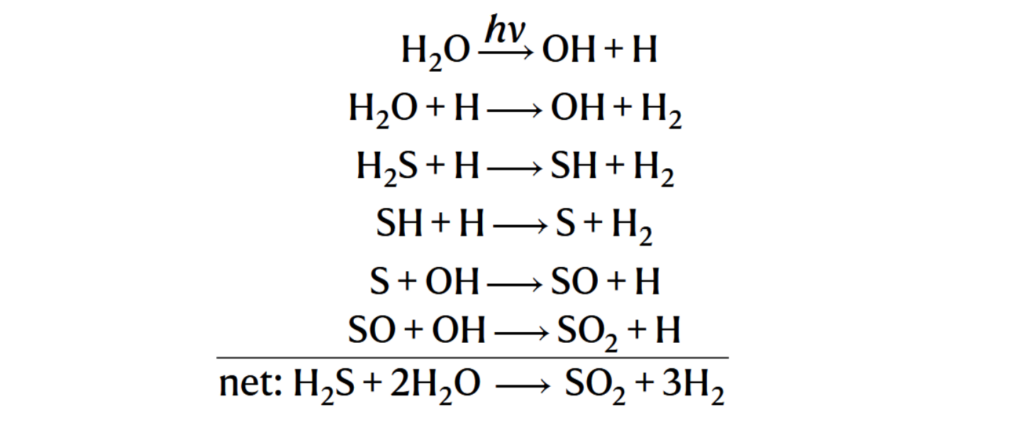
So where does this SO2 come from? It might be uncomfortable to sit with the unknown, but try let the feeling pass over you and through you. After all, meditating on the unknown is an important part of all scientific discoveries! The answer proposed by the authors of today’s paper is that the production of SO2 on WASP-39b must be driven by disequilibrium chemistry. It all starts when high-energy ultraviolet (UV) photons, coming from the planet’s star, enter the top of the atmosphere and strike a molecule of water. This causes the water molecule to split into highly reactive species called radicals (H+ and OH–). The radicals desperately seek lower energy states, so they rip apart whatever molecules are nearby, which isn’t very Zen of them. The resulting cascade of chemical reactions ultimately produces the SO2 we observe in the planet’s transmission spectrum.
Studying the Mystery
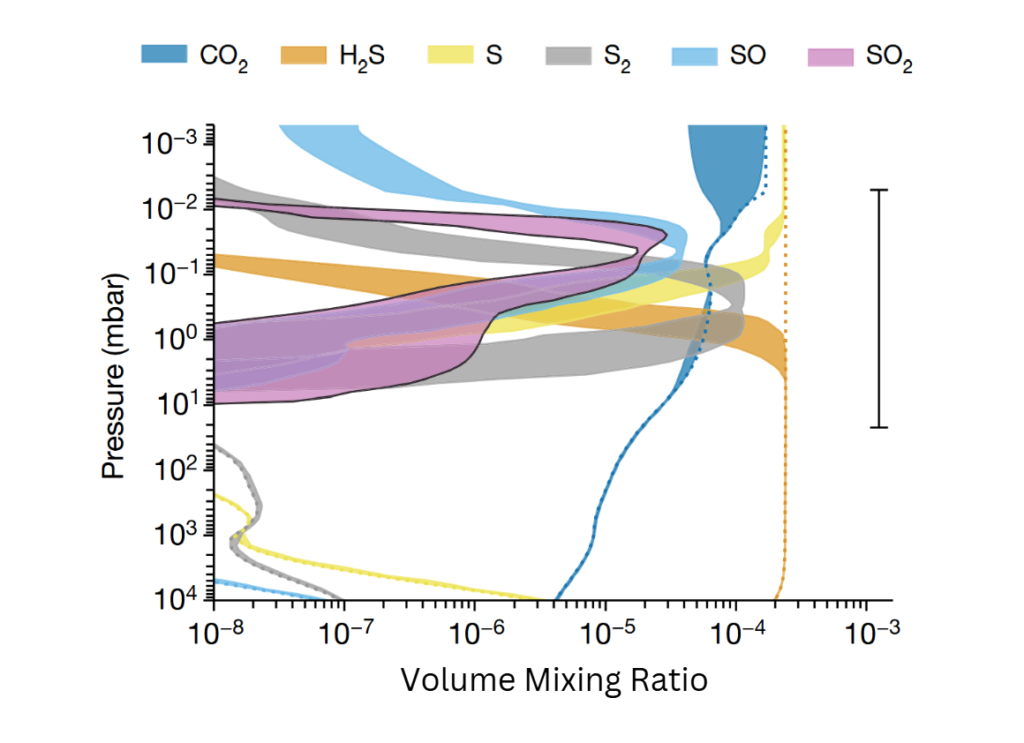
The authors of today’s paper test whether the UV-driven disequilibrium chemistry described above is capable of producing the observed SO2 on WASP-39b. They investigate this question by employing a series of disequilibrium chemical networks that track many different gas molecules and all the different ways they can react with each other. The primary network used here is called VULCAN, which features 89 types of molecules, and more than 1000 possible reactions. The networks are then evaluated by a simulation over the pressures and temperatures of WASP-39b’s atmosphere. The authors find that the disequilibrium chemical networks predict significant production of SO2, at the expense of H2S, in the upper atmosphere of WASP-39b. This shows that UV disequilibrium chemistry can provide a natural explanation for the abundance of SO2 detected by JWST.
Gold Is Not All That Glitters
Disequilibrium chemistry is often ignored when analyzing observations of faraway exoplanets due to the fact that large chemical networks can be computationally expensive to run. However, disequilibrium chemistry can have a large effect on the chemical composition of atmospheres and ignoring it may lead to incorrect interpretations of data. Furthermore, the authors highlight that paying close attention to the SO2 on hot Jupiters can be very rewarding because of what it tells us about the planet’s metal content (or metallicity). Astronomers care deeply about how much metal a planet has, because it provides information about how the planet formed. Now I should point out that astronomers, a bit unusually, refer to all atoms heavier than hydrogen and helium as ‘metals’, even if the atom in question would never be used to make nails or jewellery. As a wise guru once told me: “A king’s favourite metals are silver and gold, but an astronomer’s favourite metals are oxygen and carbon.” Since it takes three metal-bearing molecules to make one molecule of SO2 (see figure 2), the overall metal content of the planet and its formation history can be constrained by measuring its SO2.
So, the next time you feel out of equilibrium, take a moment to just breathe. It’s a cosmic truth that sometimes the universe will be in disequilibrium. From day-to-day life on Earth, to the atmospheric chemistry of WASP-39b, disequilibrium is common and may even lead to rewarding discoveries. I hope that you carry this knowledge with you to the rest of your day and are at peace. Namaste!
Astrobite edited by Sarah Stevenson
Featured image credit: Mandalasheets, Wikimedia Commons (CC0); Pablo Carlos Budassi, Wikimedia Commons, licensed under CC BY-SA 4.0
