• RSS
  • Submit a Guest Post
  • Undergraduates: Submit your Research!
  • Suggest a Paper Topic!
astrobites
  • About
    • About Astrobites
    • Meet the Authors
    • Statement of Inclusivity
    • Copyright & Permissions
  • Latest Research
    • Daily Paper Summaries
    • Classics
    • Undergrad Research
    • Physical Review Coverage
  • Beyond astro-ph
    • Beyond astro-ph Library
    • Interviews
    • Career Navigation
    • Personal Experiences
    • Current Events
    • Teaching with Astrobites
  • Guides
    • EM Spectrum
    • Galaxies & AGNs
    • Spectroscopy and Spectral Lines
    • Adaptive Optics
    • Gravitational Waves
    • Transient Astronomy
    • Astrophysical Software
    • Graduate School
    • Writing a personal statement for grad apps
    • First Observing Run
    • …More Guides!
Select Page
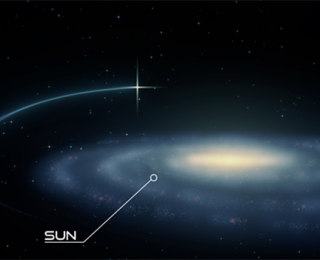
The speeding binary that shouldn’t exist

The speeding binary that shouldn’t exist

by Guest | Jul 13, 2018 | Daily Paper Summaries

A mysterious pair of stars speeding through the outskirts of our galaxy together puzzles astronomers

Yoga for dark matter: Making the Cold Dark Matter model more flexible

Yoga for dark matter: Making the Cold Dark Matter model more flexible

by Guest | Jun 28, 2018 | Daily Paper Summaries

… and therefore more powerful. Describing dark matter as a fluid allows us to model dark matter candidates with great accuracy.

Supernova Archeology with Radioactive Eyes

Supernova Archeology with Radioactive Eyes

by Guest | Jun 13, 2018 | Daily Paper Summaries

Today’s bite looks at how the ratio of various elements can inform our view of what happens during a supernova.
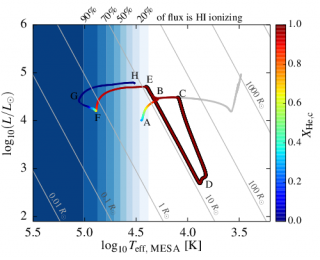
Did stripped stars re-ionize the Universe?

Did stripped stars re-ionize the Universe?

by Guest | Apr 25, 2018 | Daily Paper Summaries

We still lack a good understanding of the source of ionizing photons in the early Universe. Can envelope-stripping from a binary companion help stars to re-ionize the early universe?
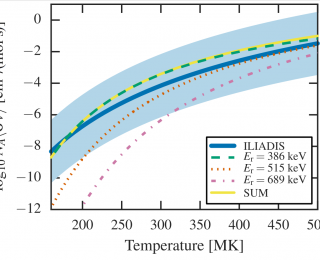
The Nuclear Physics of Exploding Stars

The Nuclear Physics of Exploding Stars

by Guest | Apr 23, 2018 | Daily Paper Summaries

For the first time ever, this paper uses experiments – real nuclear reactions performed in the lab – to help address gaps in our understanding of classical novae.

« Older Entries
Next Entries »

Loading

Follow our socials

  • Bluesky
  • Facebook
  • Instagram
  • RSS Feed

More Posts About

AAS AGN astronomy astrophysics binary stars black holes cosmology dark matter dwarf galaxies exoplanets galaxies galaxy evolution gravitational waves habitability JWST Kepler Milky Way observations planetary science planet formation protoplanetary disks radio astronomy simulations solar system spectroscopy star formation stars stellar evolution supernovae theory

Posts by Category

  • Accessibility
  • Applications
  • Beyond
  • Book Reviews
  • Career Navigation
  • Classics
  • Climate Change
  • Course Assignments
  • Crossposts
  • Current Events
  • Daily Paper Summaries
  • Game Reviews
  • Guides
  • Historical Astronomy
  • Instrumentation
  • Interviews
  • Outreach
  • Personal Experiences
  • PRJ
  • Quick Notes
  • Satellites
  • Teaching
  • Undergraduate Research

More Astronomy

  • AAS
  • AAS Nova
  • astro-ph
  • AstroBetter
  • APOD

Read Astrobites in Other Languages

  • Astrobitos (Spanish)
  • Astropontos (Portuguese)
  • staryab (Farsi)

Listen to Astrobites

  • astro[sound]bites

Discover More Incredible Science

  • ScienceBites Network
  • RSS

© 2026 Astrobites | All Rights Reserved | Supported by AAS | Designed by Elegant Themes | Powered by WordPress