
We’re Going to Steal the Moon (For Gravitational Waves)
The authors of today’s bite explore how lunar mountains and crust can act as the perfect detector for detecting ripples in spacetime.

The authors of today’s bite explore how lunar mountains and crust can act as the perfect detector for detecting ripples in spacetime.
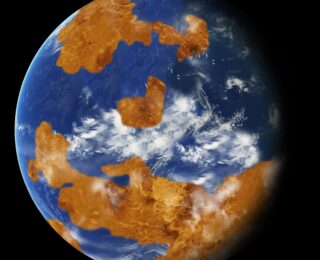
The geologic carbon cycle has been an important tool for balancing carbon dioxide and stabilizing the climate of Earth over billions of years. The authors of today’s bite explore why dry planets may be missing this critical climate-stabilizing thermostat.
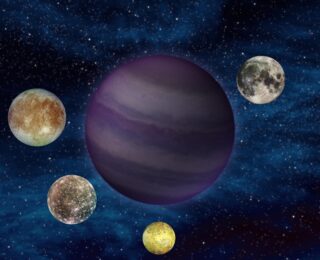
Moons are abundant within our own solar system, but astronomers have historically struggled to find moons (exomoons) within other systems beyond our own. Yet, today’s authors suggest that the James Webb Space Telescope may be the key for solving this missing exomoon problem.

In today’s bite, we’ll be exploring the turbulent skies of WISE 1049AB, one of the closest known systems to our own solar system. We’ll see how observations can reveal the nature of their atmospheres and how they can be used to better understand atmospheres of other giant planets.