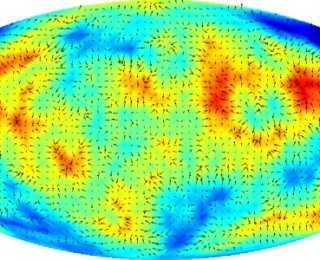
Gravitational Lensing of the CMB
The South Pole Telescope collaboration detects the effects of gravitational lensing on the cosmic microwave background and derives improved constraints on several cosmological parameters.

The South Pole Telescope collaboration detects the effects of gravitational lensing on the cosmic microwave background and derives improved constraints on several cosmological parameters.
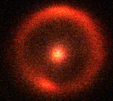
A new dwarf galaxy has been detected a record-breaking 10 billion light years from Earth, using a method based on gravitational lensing. The satellite galaxy is composed mainly of dark matter and is too faint to be observed directly with the current generation of optical telescopes.
Last year on Christmas day, scientists observed a unique gamma-ray burst, GRB 101225A. Two interesting and very different models have developed for the ‘Christmas burst:’ a tidal disruption of a comet by a neutron star somewhere in our Galaxy, or a neutron star consuming its companion star over 5 billion light years away.
Researchers at Penn State aim to determine the probability that artifacts from allien civilizations are present in our Solar System.
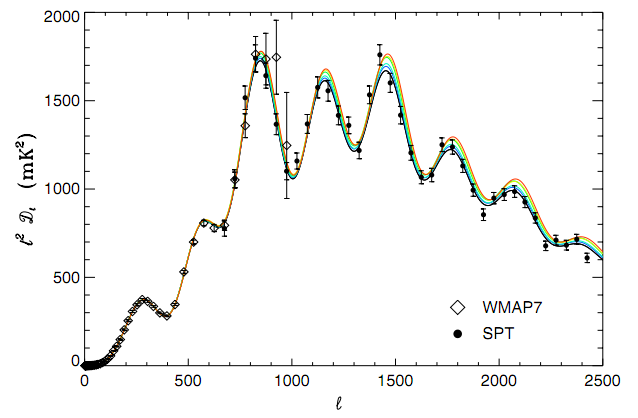
Dark energy is causing the expansion of the universe to accelerate. The most common model for dark energy has a negligible dark energy density in the early universe. The authors use measurements of the CMB power spectrum to constrain the density of dark energy in the early universe.