by Sukrit Ranjan | Jul 25, 2012 | Daily Paper Summaries
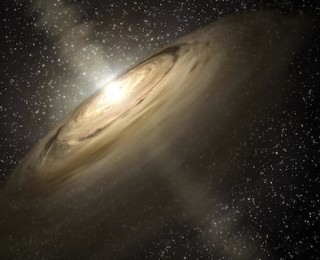
Planet formation theory predicts a water-rich Earth. On a comparative basis, the Earth is water-poor. This paper aims to reconcile theory and observation.
by Sukrit Ranjan | May 31, 2012 | Daily Paper Summaries
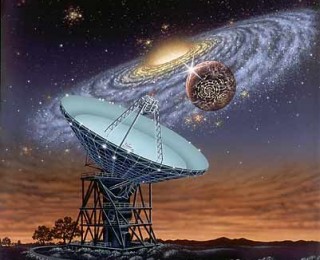
This paper describes the first-ever application of the technique of Very Long Baseline Interferometry (VLBI) to the Search for Extra-Terrestrial Intelligence (SETI).
by Sukrit Ranjan | May 3, 2012 | Daily Paper Summaries
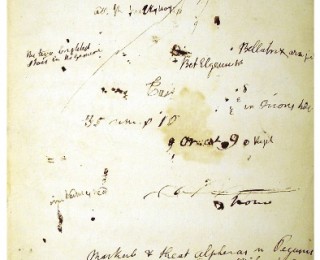
• Paper title: John Goodricke, Edward Pigott, and Their Study of Variable Stars (arXiv: 1204.6241) • Author: Linda M. French • First Author’s Affiliation: Illinois Wesleyan University• Journal: American Association of Variable Star Observers (accepted)OverviewOne of the things I like about astronomy is its rich history. There are records of astronomical studies being done right back to the earliest civilizations in India, Mesopotamia, and Egypt. It’s kind of cool to realize that as an astronomer, you’re a member of a millenia-old intellectual tradition!Of course, early astronomy was more astrology and calendar-keeping than the rigorous cousin of physics it is today. Today’s paper presents a snapshot taken just as astronomy was transitioning to the modern scientific era. The author studies the lives and works of two of the first variable star observers, using primary source material to explore how they lived, worked, and thought.MethodThe author spent a sabbatical at the university of York, studying the journals and papers of the English astronomers John Goodricke and Edward Pigott related to their discovery and characterization of variable stars. While the bulk of the paper is biographical in nature and best read as part of a whole, there are a few things that jumped out at me.First, England was a surprisingly progressive place by the late 1700s. A common misconception about premodern Europe is that it was always a challenging environment for scientists (think Galileo, Darwin, and Bruno). In this model, the scientist is a “lone, heroic figure” (French 2012), who must struggle to enlighten backward society. While this may have been true during the Renaissance, by the late 1700s a surprisingly intellectually...
by Sukrit Ranjan | Mar 7, 2012 | Daily Paper Summaries
• Paper title: A Note on Solar Cycle Length During the Medieval Climate Anomaly (arXiv: 1203.1073)• Authors: J. M. Vaquero, R. M. Trigo• First Author’s Affiliation: Centro Universitario de Mérida• Journal: Solar Physics (Accepted)Introduction and MotivationOne of the pressing questions facing climate science today is understanding how the Sun’s behavior evolves over time. Since the Sun is the main source of energy for Earth’s atmosphere, comprehending how solar irradiance changes over time is key to interpreting past climatological events. If we went through a period of abnormal temperatures in the past, was it due to changes in the Sun’s radiance, or was it due to some more complex interplay between the components of climate on Earth?You might think we’re up the creek without a paddle – how are we going to measure solar output centuries and millennia in the past? Fortunately, two facts intervene to save us. First, there exists an empirical link between the solar cycle length (SCL) and its amplitude. The Sun goes through cycles of increased and decreased intensity on an ~11 year timescale. The exact length of this cycle is tied to its amplitude, which means that by measuring the SCLs we can constrain the activity levels of the sun – and hence its total irradiance over time. Second, as it turns out, our ancestors were pretty darned intellectually curious! Among other things, they kept records of the sunspots and aurorae they observed every year; both phenomena are tightly correlated with solar activity. By looking at records of these events, scientists have been able to determine SCLs from many different epochs. Don’t try this at...
by Sukrit Ranjan | Feb 9, 2012 | Daily Paper Summaries
• Paper title: One Or More Bound Planets Per Milky Way Star From Microlensing Observations (arXiv: 1202.0903) • Authors: Arnaud Cassan et al • First Author’s Affiliation: Institut d’Astrophysique de Paris, Paris, France.• Journal: NatureIntroduction and MotivationThe objective of this paper was to determine the distribution of planets across the entire galaxy, broken down by mass and semimajor axis, from microlensing data. Previous surveys have focused on data from the Doppler (radial velocity) and transit methods, which are both biased to preferentially detect hot, close-in planets. Microlensing, in contrast, is ideally suited for finding cool planets far from their host stars.Figure 1 illustrates the microlensing technique, which depends on the use of a foreground lensing object’s gravity to magnify the light of a background object. When one star (the “lens”) passes in front of another, gravitational lensing amplifies the background star’s light. If this foreground star is orbited by another object (such as a planet), and the object intersects the star’s Einstein ring, its gravity causes an additional spike in the measured intensity from the background object. The duration of lensing events can range from minutes to days, and provides constraints on a planet’s mass, semimajor axis, and period. While these events require precise alignment of two stars, and thus are infrequent, the incredible wealth of information gleaned from them – and their ability to find planets further from their host stars than the transit and radial velocity methods can – makes microlensing an indispensable technique for the planet hunter. Methods and ResultsThe authors studied the detection rates from the PLANETS microlensing survey from 2002-2007, and then extrapolated the survey’s...
