

Jupiter: Friend or Foe?
Paper title: Jupiter: Friend or Foe IV: The Influence of Orbital Eccentricity and Inclination (arXiv:1111.3144) Authors: J. Horner, B. W. Jones First Author’s Affiliation: University of New South Wales, Sydney, Australia MotivationThe hunt is on to find habitable exo-Earths, but what does “habitable” actually mean? The traditional definition of habitability focuses on the surface temperature of the planet: specifically, is it in the correct range to support liquid water? However, there are many other components to habitability. For example, if the star is too active and the planet too close to it, stellar activity and radiation may create a hostile environment for life to form. Another constraint on habitability comes from meteorite impacts: if the planet is hit by the equivalent of a Yucatan impactor (i.e. the one that killed the dinosaurs) every few millenia, it will be challenging for complex life to evolve there!In this paper, Horner and Jones focus on the impactor constraint for habitability. The existence of Jupiter is often cited as a factor in Earth’s habitability because the larger planet gravitationally shields Earth from most asteroid and cometary impacts. However, Jupiter is on a very sedate, low-eccentricity, low-inclination orbit, and the search for exoplanets has turned up gas giants with a wide range of inclinations and eccentricities. How would varying the eccentricity and inclination of Jupiter affect the impact rate on Earth? This is the question this paper asks. By understanding the influence of co-systemic giant planet eccentricity and inclination on the rate of impacts onto potentially habitable planets, it will be possible to more tightly focus the search for habitable exoplanets on systems that...
ExoMoons and ExoEarths
• Paper title: Modeling the Infrared Spectrum of the Earth-Moon System: Implications for the Detection and Characterization of Earthlike Extrasolar Planets and their Moonlike Companions (arXiv:1110.3744v1) • Authors: Tyler D. Robinson • First Author’s Affiliation: University of WashingtonIntroduction The holy grail of exoplanet scientists is the detection and characterization of a true Earth-analog, an “Earth-twin” orbiting another star. A number of great studies have been done towards this goal; see for example the EPOXI mission, which turned the sensors on Deep Impact back towards Earth to see what we could learn about its atmosphere from remote observation alone. Yet many of these studies consider the Earth in isolation. They ignore the fact that we have a very significant companion in the form of the Moon. Given how close the Earth and Moon orbit, it is unlikely that any exoplanet characterization mission we can envision will be able to resolve an Earth-Moon system analog (the Earth-Moon separation would be 5 milliarcseconds at just 5 parsecs). Therefore, any spectra we take of a terrestrial planet would likely include flux from unseen companions. Recent planet formation modelling suggests that impacts of the kind that formed the Moon may be common. What would be the effect of a lunar companion on measured atmospheric spectra, and how might we ascertain the existence of such a companion? This article explored these questions.MethodThis paper builds on previous work that looked for the effect of a lunar body on an Earth-analog in a bolometric (i.e. total luminosity) sense, which found that the orbiting body needed to be Mars-sized in order to be detectable through broadband photometry. In...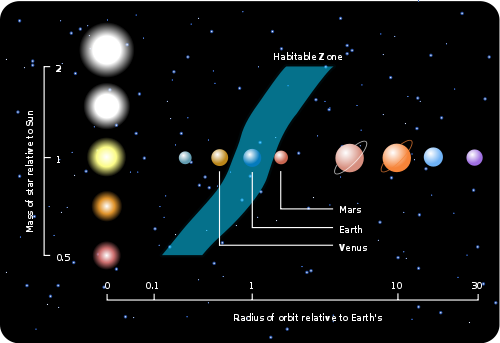
Dark Matter and Planet Habitability
This eye-catching theory paper asks an elegant but simple question: when dark matter is gravitationaly captured by a planet, can the energy released when it annihalates provide enough heat to make the planet habitable?