by Madison VanWyngarden | Jun 24, 2026 | Daily Paper Summaries
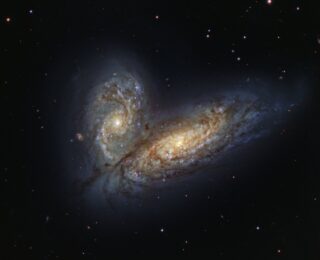
How did supermassive black holes in the early universe get so massive? Today’s bite uses simulations to investigate whether galaxy mergers can help beef up black holes.
![[Guest post] Excavating Exoplanets: How to Dust off Debris Disks Using a New High-Contrast Imaging Technique](https://astrobites.org/wp-content/uploads/2026/05/Screenshot-2026-06-01-at-10.50.56-AM-320x260.png)
by Guest | Jun 23, 2026 | Daily Paper Summaries
What do astronomers and archaeologists have in common? Today’s guest author discusses how faint exoplanet signals are extracted from their noisy surroundings.
by Ryan White | Jun 22, 2026 | Daily Paper Summaries
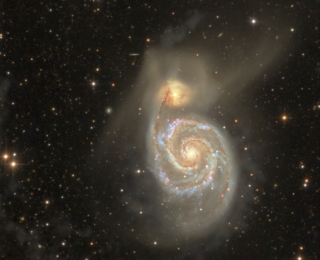
Stream in to today’s paper to understand how tearing apart dwarf galaxies can reveal the shape of the dark matter haloes of hungry galaxies.
by Natalie Price | Jun 18, 2026 | Current Events, Daily Paper Summaries, Interviews
Where do the elements on the periodic table come from? Tune into Dr. Ian Roederer’s Plenary Lecture at #AAS248 to find out!
![[Guest] The Walking Dead: Warm Worlds Around Dead Stars](https://astrobites.org/wp-content/uploads/2026/06/IMG_8429-320x260.jpeg)
by Guest | Jun 17, 2026 | Daily Paper Summaries
For today’s bite guest author, Savaria Parrish, explores the prospects for habitability on planets around a class of stellar remnants known as white dwarfs!
by Guest | Jun 15, 2026 | Daily Paper Summaries
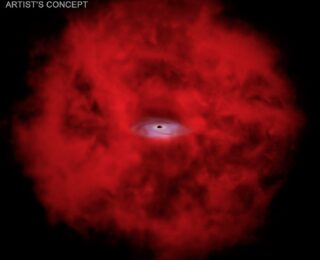
This guest post was written by Aylin Garcia Soto, a graduating Ph.D. student from Dartmouth University studying M dwarf variability. She will start a postdoc at Boise State University working with Dr. Brian Jackson on tidal decay in exostellar systems. Outside of research, she enjoys reading, watching K dramas (and other dramas), playing guitar, and writing creative stories. Title: Exploring the Active Galactic Nucleus Fraction of a Sample of JWST’s Little Red Dots at 4 < z < 8: Overmassive Black Holes Are Strong Flavored Authors: Emmanuel Durodola, Fabio Pacucci, Ryan C. Hickox First Author’s Institution: Department of Physics & Astronomy, Dartmouth College, Hanover, NH 03755, USA Status: Published in ApJ [open access] The Little Red Dot Once upon a time there was an object called Little Red Dot. It lived a long long long (over 12 billion years) ago with a big big big (x10) ol’ black hole wrapped in a large dusty blanket. One day, a gentle-telescope named JWST took its camera to visit its universe, and on its way, it bumped into Little Red. Oh my, what a red, old, compact galaxy you are. All the better to confuse you with, my dear scientist. What strange spectral energy distribution you present. All the better to keep you guessing (what I am). The Little Red Dots and Modern AGNs Much of what we know about Little Red Dots (LRDs) arose after 2024 thanks to data from the JWST space telescope. These red objects represent emitted light from high-redshift or distant objects that formed about 1.5 billion years after the big-bang (13.8 billion years ago). To measure the...
