by Guest | Jun 15, 2026 | Daily Paper Summaries
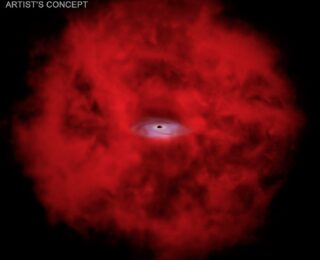
This guest post was written by Aylin Garcia Soto, a graduating Ph.D. student from Dartmouth University studying M dwarf variability. She will start a postdoc at Boise State University working with Dr. Brian Jackson on tidal decay in exostellar systems. Outside of research, she enjoys reading, watching K dramas (and other dramas), playing guitar, and writing creative stories. Title: Exploring the Active Galactic Nucleus Fraction of a Sample of JWST’s Little Red Dots at 4 < z < 8: Overmassive Black Holes Are Strong Flavored Authors: Emmanuel Durodola, Fabio Pacucci, Ryan C. Hickox First Author’s Institution: Department of Physics & Astronomy, Dartmouth College, Hanover, NH 03755, USA Status: Published in ApJ [open access] The Little Red Dot Once upon a time there was an object called Little Red Dot. It lived a long long long (over 12 billion years) ago with a big big big (x10) ol’ black hole wrapped in a large dusty blanket. One day, a gentle-telescope named JWST took its camera to visit its universe, and on its way, it bumped into Little Red. Oh my, what a red, old, compact galaxy you are. All the better to confuse you with, my dear scientist. What strange spectral energy distribution you present. All the better to keep you guessing (what I am). The Little Red Dots and Modern AGNs Much of what we know about Little Red Dots (LRDs) arose after 2024 thanks to data from the JWST space telescope. These red objects represent emitted light from high-redshift or distant objects that formed about 1.5 billion years after the big-bang (13.8 billion years ago). To measure the...
by Jayde Willingham | Jun 13, 2026 | Daily Paper Summaries, PRJ
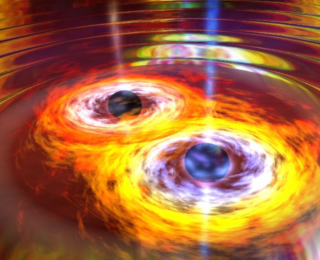
GW231123 defies our best models of stellar collapse, hosting two black holes that shouldn’t exist. A new paper proposes a radical solution: these monsters may have been born in the early universe as primordial black holes, quietly feeding for billions of years until they became the record-breakers we detected today.
by Margaret Verrico | Jun 12, 2026 | Daily Paper Summaries
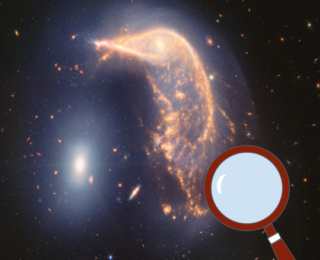
Who killed star formation in massive elliptical galaxies 8 billion years ago? The EXCELS survey uses JWST to find out!
![[Guest post] The Secret Life of sub-Neptunes and super-Earths](https://astrobites.org/wp-content/uploads/2026/05/subneptune-320x260.png)
by Guest | Jun 11, 2026 | Daily Paper Summaries
There’s a puzzling gap in the distribution of exoplanet sizes. Today’s paper explores the role of photoevaporation and core composition on the formation of the radius valley.
by Chloe Klare | Jun 10, 2026 | Daily Paper Summaries
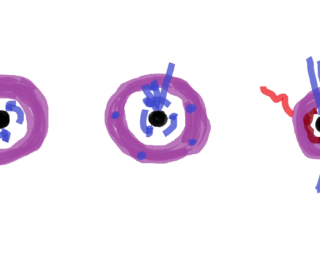
Black hole accretion must be SANE or MAD, right? Maybe not…read to learn more!
![[Guest post] Inviting dimmer cousins to the party](https://astrobites.org/wp-content/uploads/2026/05/lsbg_vs_hsbg_meme-320x260.jpg)
by Guest | Jun 9, 2026 | Daily Paper Summaries
Are fainter galaxies really different than brighter ones? This study reveals that, despite being dimmer, low surface brightness galaxies obey the same fundamental laws of galaxy formation, offering new clues about how galaxies and dark matter halos evolve.
