by Brett Deaton | Dec 18, 2013 | Daily Paper Summaries
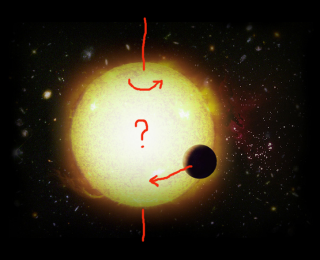
How do so many hot jupiters come to orbit backwards?
by Yvette Cendes | Dec 16, 2013 | Daily Paper Summaries
Title: Fast Radio Bursts May Originate from Nearby Flaring Stars Authors: Abraham Loeb, Yossi Shvartzvald, Dan Maoz First Author’s Institution: Institute for Theory and Computation, Harvard University Paper Status: MNRAS, in press One of the most intriguing discoveries in radio astronomy in recent years has been the discovery of Fast Radio Bursts (FRBs). Originally called Lorimer bursts after the first (and for some time, only) burst observed, there are currently six of these bursts published in the literature, and astronomers are puzzled because they look very different from any other astronomical signals observed before. They are bright- FRBs are the brightest astronomical phenomena seen in radio frequencies, and they don’t seem to have known counterparts in other wavelengths. They are brief- a burst only lasts a few microseconds, and they don’t seem to repeat. And they have a very high dispersion measure (DM)- a relationship between time and frequency that tells you how far away a signal comes from (explained well in this Astrobite)- which has indicated an extragalactic origin for FRBs. To writ, what exactly FRBs are and where they come from is a mystery.In this paper, the authors decided to take a different track from previous theories about FRB origins that point to extragalactic sources, and instead tackled the option of a much more local origin. Their proposed candidate sources are flare stars– variable stars which can undergo dramatic and unpredictable increases in brightness. Flare stars are typically dim dwarf stars, and some are already known to produce radio bursts with brief rise times on the order of milliseconds, thought to be produced by cyclotron maser mechanisms in the stellar atmospheres. ...
by Erika Nesvold | Dec 13, 2013 | Daily Paper Summaries
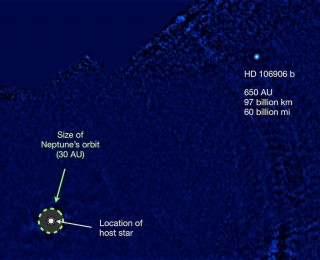
The Magellan telescope has directly imaged a planetary-mass companion at a projected distance of 650 AU from its star! Read on to find out how the authors detected and characterized this companion, and how they think it got there.
by Ruth Angus | Dec 12, 2013 | Daily Paper Summaries
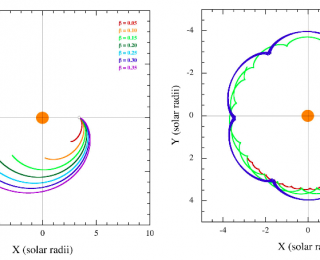
KOI 2700b is a planet with an identity crisis: it thinks it is a comet.
by Elisa Chisari | Dec 11, 2013 | Daily Paper Summaries
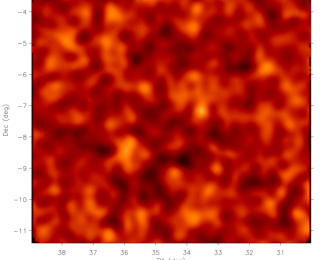
Gravitational lensing is the deflection of the trajectory of a photon by gravity, and it is a natural consequence of the theory of General Relativity. Lensing distorts the shapes and orientations of galaxies and in today’s post, we discuss a new method to reconstruct dark matter maps of our Universe using the position angles of galaxies.
by Meredith Rawls | Dec 10, 2013 | Daily Paper Summaries
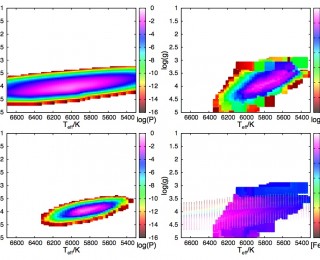
The link between a pile of data and a physical explanation is the fun part. Astronomers spend countless hours gathering data, and countless more thinking up physical models for different pieces of the Universe. But reconciling these two things—finding a model that not only agrees with observations, but is the sole likely explanation—isn’t easy.
