by Justin Vasel | Aug 10, 2012 | Daily Paper Summaries
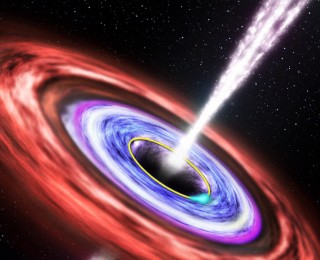
If there was a cosmic play with the universe as its stage and the celestial bodies as its actors, undoubtedly there would be one character more notorious than the rest; a villain feared by all: the infamous Black Hole. They are truly the things of nightmares, and for one little star out there, that nightmare came true.
by Dan Gifford | Aug 7, 2012 | Daily Paper Summaries
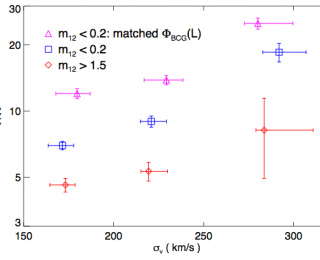
Need to improve a relationship between 2 parameters? Why not try adding a 3rd!
by Courtney Dressing | Aug 2, 2012 | Daily Paper Summaries
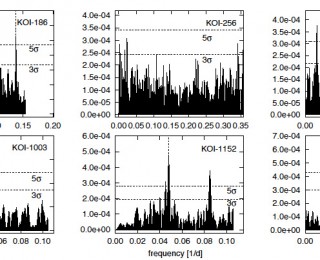
The leading theory is that hot Jupiters tend to occur in single planet systems, but Szabo et al. find evidence that some hot Jupiters might reside in multi-planet systems. Are hot Jupiters actually lonely?
by Elisabeth Newton | Aug 1, 2012 | Daily Paper Summaries
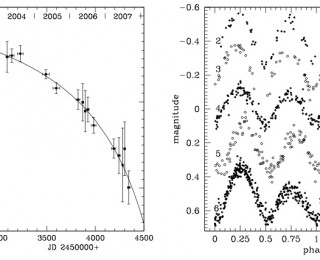
V1309 Sco first caught astronomers attention in 2008, when it displayed an outburst, suddenly getting a hundred times brighter. Due its location near the Galactic center, V1309 Sco has been monitored by the OGLE, which is looking for microlensing events, since 2001. The authors of this paper were able to look back into this archive of data and see what V1309 Sco was doing before it erupted.
by Alice Olmstead | Jul 31, 2012 | Daily Paper Summaries
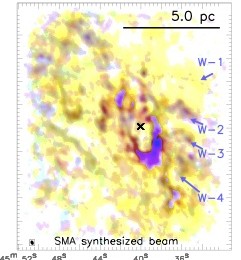
Recent studies have revealed a surprising amount of activity happening in the heart of our own Milky Way. In this paper, Liu et al. explore the kinematics of the gas outside the most central regions of our galaxy, and reveal that the Galactic center is being fed even more material from the main structure of the Milky Way.
by Elizabeth Lovegrove | Jul 31, 2012 | Daily Paper Summaries
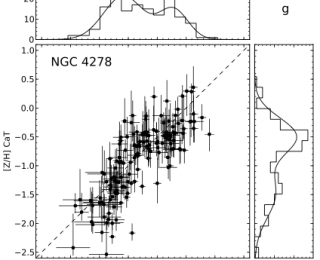
In this paper, the SLUGGS team explores an alternate way to determine the metallicity of a globular cluster based on the calcium triplet rather than color. Previous studies have shown what appear to be two peaks in the metallicity of the population of globular clusters surrounding early-type galaxies – a bimodal distribution – but some astronomers have pointed out that the way we measure metallicity in globular clusters can make a unimodal distribution in metallicity appear as a bimodal one. The SLUGGS team recalibrates the calcium triplet relation and surveys 903 clusters around 11 galaxies, and finds a similar bimodal distribution, implying that most massive galaxies undergo at least two star formation episodes.
