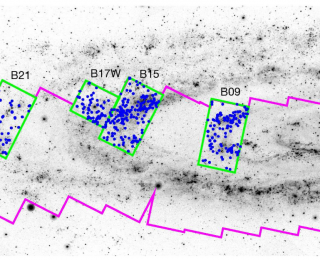
An island universe of star clusters in Andromeda
Today, I’ll be discussing new results from the Panchromatic Hubble Andromeda Treasury (PHAT) survey.

Today, I’ll be discussing new results from the Panchromatic Hubble Andromeda Treasury (PHAT) survey.
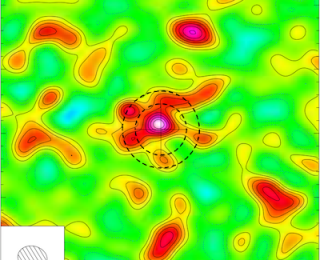
The idea of “negative feedback” on star formation in galaxies is ubiquitous, but the debate about what causes the massive outflows we see in galaxies is far from over. Now, Maiolino et al. have found evidence of a massive quasar-driven outflow at z > 6, making it the earliest instance yet of a central black hole affecting its host galaxy on a global scale.
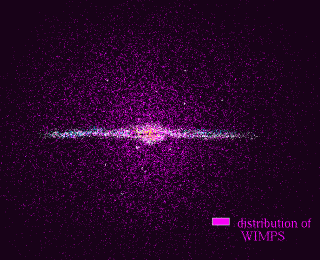
If WIMPs are the solution to the dark matter problem, it’s reasonable to ask what sort of impact they would have on human beings. This paper answers that question.
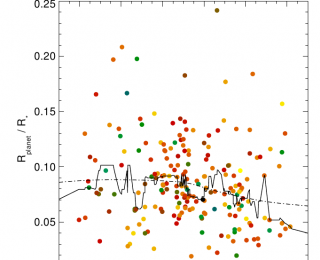
Sarah Dodson-Robinson identifies a correlation between planetary radius and stellar metallicity among gas giants in the Kepler catalog that may indicate a change in the structure and formation mechanism of planets over cosmic time.
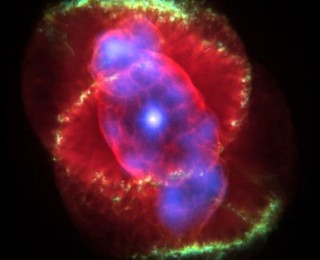
It’s a fact of the universe that most stars are members of a binary system. However, our knowledge of stellar evolution has most thoroughly treated the case of a single, isolated star evolving according to its own schedule, dictated by the well-understood equations of stellar structure. What happens when the binary stars have tight enough orbits to influence each other?
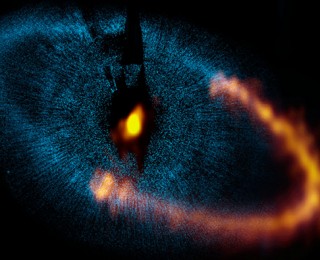
The first science results from ALMA include remarkable images of the dust ring encircling the notorious Fomalhaut. Modeling of the ring’s morphology suggests the existence of two planets, each with a mass comparable to the mass of the Earth.