by Shannon Hall | Apr 29, 2012 | Daily Paper Summaries
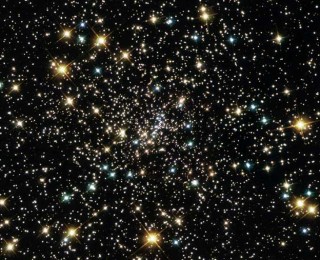
Blue stragglers are stars within a globular cluster that lie along an extension of the main-sequence, above the turnoff point. As such they appear to be much younger than the rest of their stellar population. Current research suggests that they form by coalescence of mass-transfer between two companions in a binary system and the merger of two stars induced by stellar collision. By observing the population distributions of blue stragglers in globular clusters we can learn about the mechanisms through which they formed and the evolutionary dynamics of the cluster itself.

by Adele Plunkett | Apr 27, 2012 | Daily Paper Summaries
This paper suggests a new quantity to measure the brightness of gas emission throughout the Milky Way, and determines the regions where most stars are likely to be forming in our Galaxy.

by Courtney Dressing | Apr 26, 2012 | Daily Paper Summaries
Many Super-Earths appear to be less dense than the Earth. How do such planets form? Could a rocky Super-Earth accrete a hydrogen-helium atmosphere in-situ?
by Elisabeth Newton | Apr 26, 2012 | Daily Paper Summaries
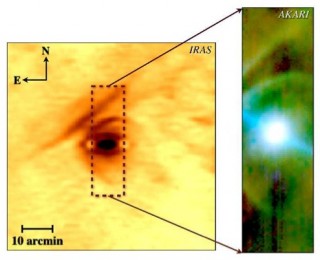
Sometimes we see strange shapes when we look through our fancy telescopes and we’re left wondering how they formed. How did the rings and “pearls” of SN1987A form? Or the hexagonal cloud pattern on Saturn? The star Betelgeuse – famous for being Orion’s left shoulder – presents another unusual geometric appearance.
by Anna Rosen | Apr 24, 2012 | Daily Paper Summaries
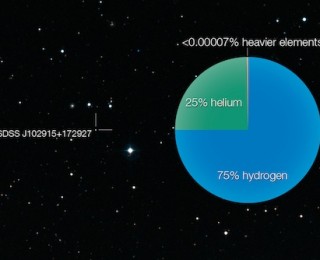
The low-mass primitive halo star, SDSS J102915+172927, puzzled astronomers because of it’s extremely low metal content. This article aims to answer under what physical conditions can a star like this form.

by Kirit Karkare | Apr 24, 2012 | Daily Paper Summaries
Why are there so few X-ray imaging polarimeters? This paper determines the intrinsic sensitivity of stacked imaging detectors to hard X-ray polarization.
