by Elisabeth Newton | May 9, 2012 | Daily Paper Summaries
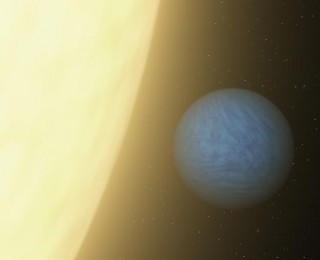
Last year, I reported on how the mystery of 55 Cancri e was resolved. In this Letter, Demory et al. observe the secondary eclipses of 55 Cnc e (when the planet passes behind the star), allowing them to determine the planet’s temperature. At 3,800 degrees Fahrenheit: this super Earth is not looking like a good vacation spot. They are also able to explore possible compositions for the planet.
by Allison Strom | May 7, 2012 | Daily Paper Summaries
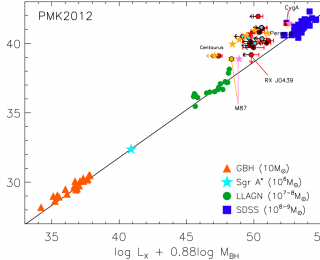
A team of astronomers at the University of Cambridge have uncovered evidence for ultramassive black holes in the giant elliptical galaxies that sit at the center of galaxy clusters. These whoppers could be up to ten times more massive than ordinary supermassive black holes, like the ones we usually find in centers of galaxies.
by Lucia Morganti | May 5, 2012 | Daily Paper Summaries
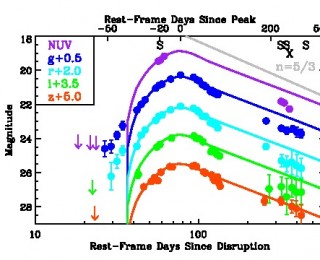
A luminous ultraviolet-optical flare of radiation reveals the tidal disruption of a star wandering on a quasi-parabolic orbit in the vicinity of a supermassive black hole. This is the most direct evidence yet of a supermassive black hole shredding a star that swirled too close.
by Caroline Morley | May 3, 2012 | Daily Paper Summaries
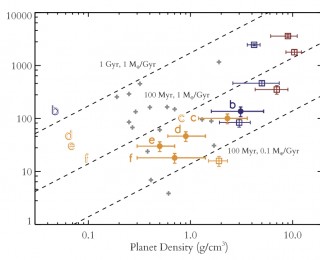
To characterize the newly-discovered population of small planets, this team from UC Santa Cruz investigated how planets lose mass over their lifetimes, and determined how this loss will affect planet populations. This paper suggests that we can understand the population of small planets using mass loss models, and we make predictions using these models for the masses of irradiated super-Earths.
by Sukrit Ranjan | May 3, 2012 | Daily Paper Summaries
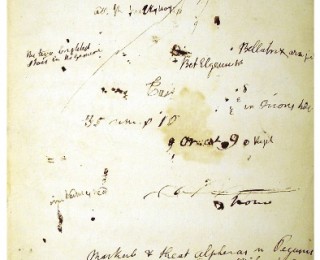
• Paper title: John Goodricke, Edward Pigott, and Their Study of Variable Stars (arXiv: 1204.6241) • Author: Linda M. French • First Author’s Affiliation: Illinois Wesleyan University• Journal: American Association of Variable Star Observers (accepted)OverviewOne of the things I like about astronomy is its rich history. There are records of astronomical studies being done right back to the earliest civilizations in India, Mesopotamia, and Egypt. It’s kind of cool to realize that as an astronomer, you’re a member of a millenia-old intellectual tradition!Of course, early astronomy was more astrology and calendar-keeping than the rigorous cousin of physics it is today. Today’s paper presents a snapshot taken just as astronomy was transitioning to the modern scientific era. The author studies the lives and works of two of the first variable star observers, using primary source material to explore how they lived, worked, and thought.MethodThe author spent a sabbatical at the university of York, studying the journals and papers of the English astronomers John Goodricke and Edward Pigott related to their discovery and characterization of variable stars. While the bulk of the paper is biographical in nature and best read as part of a whole, there are a few things that jumped out at me.First, England was a surprisingly progressive place by the late 1700s. A common misconception about premodern Europe is that it was always a challenging environment for scientists (think Galileo, Darwin, and Bruno). In this model, the scientist is a “lone, heroic figure” (French 2012), who must struggle to enlighten backward society. While this may have been true during the Renaissance, by the late 1700s a surprisingly intellectually...
by Maria Drout | Apr 30, 2012 | Daily Paper Summaries
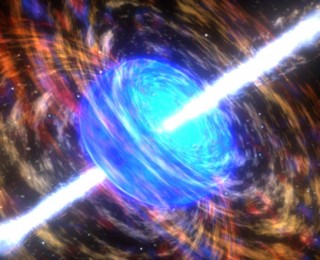
Astronomers detect a jet break in the X-ray afterglow of short GRB 111020A.
