by Allison Strom | Mar 12, 2012 | Daily Paper Summaries
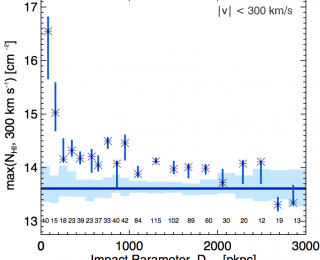
Researchers at Caltech have used data from the Keck Baryonic Structure Survey to place quantitative constraints on the circumgalactic medium around galaxies at z~2. Measurements like these help us fine-tune our understanding of the interplay between gas and galaxies and, ultimately, galaxy formation and evolution.
by Kim Phifer | Mar 11, 2012 | Daily Paper Summaries
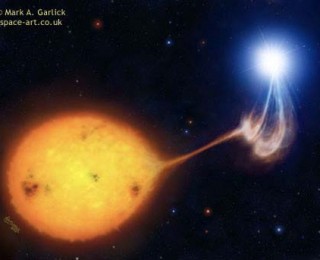
Rebassa-Mansergas et al. investigate two long period post common envelope systems in order to place constraints on the energy budget for common envelope evolution.
by Susanna Kohler | Mar 9, 2012 | Daily Paper Summaries
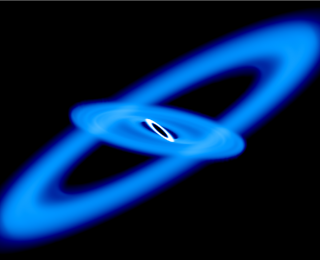
How fast can you grow a supermassive black hole by accretion? That depends on how much you tilt the disk…
by Lucia Morganti | Mar 9, 2012 | Daily Paper Summaries
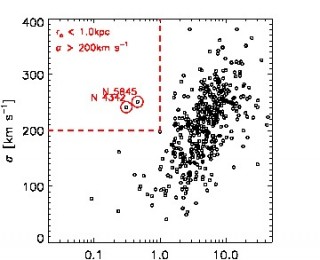
NGC 5845 is a nearby compact galaxy, more similar to the recently discovered high redshift z~2 compact galaxies than to its low-redshift mates. This makes it rare and interesting, as its structure and kinematics can be studied much better than is possible at high redshift. The analysis reveal a prominent rotating stellar disk, suggesting that similar structures could be present in high-redshift compact galaxies too.
by Sukrit Ranjan | Mar 7, 2012 | Daily Paper Summaries
• Paper title: A Note on Solar Cycle Length During the Medieval Climate Anomaly (arXiv: 1203.1073)• Authors: J. M. Vaquero, R. M. Trigo• First Author’s Affiliation: Centro Universitario de Mérida• Journal: Solar Physics (Accepted)Introduction and MotivationOne of the pressing questions facing climate science today is understanding how the Sun’s behavior evolves over time. Since the Sun is the main source of energy for Earth’s atmosphere, comprehending how solar irradiance changes over time is key to interpreting past climatological events. If we went through a period of abnormal temperatures in the past, was it due to changes in the Sun’s radiance, or was it due to some more complex interplay between the components of climate on Earth?You might think we’re up the creek without a paddle – how are we going to measure solar output centuries and millennia in the past? Fortunately, two facts intervene to save us. First, there exists an empirical link between the solar cycle length (SCL) and its amplitude. The Sun goes through cycles of increased and decreased intensity on an ~11 year timescale. The exact length of this cycle is tied to its amplitude, which means that by measuring the SCLs we can constrain the activity levels of the sun – and hence its total irradiance over time. Second, as it turns out, our ancestors were pretty darned intellectually curious! Among other things, they kept records of the sunspots and aurorae they observed every year; both phenomena are tightly correlated with solar activity. By looking at records of these events, scientists have been able to determine SCLs from many different epochs. Don’t try this at...
by Maria Drout | Mar 7, 2012 | Daily Paper Summaries
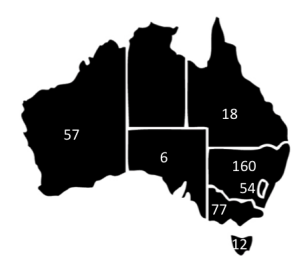
We review two recent articles which discuss trends in the authors of astronomical publications. One examines the citation history for Australian Astronomers and the second examines the “demise of the lone-author”.
