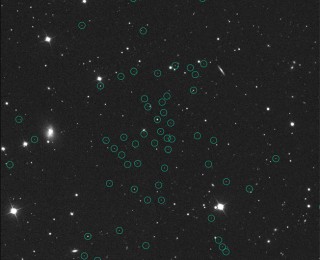
What Defines a Galaxy?
“A galaxy is a gravitationally bound collection of stars whose properties cannot be explained by a combination of baryons and Newton’s laws of gravity.” (Willman & Strader, http://arxiv.org/abs/1203.2608)

“A galaxy is a gravitationally bound collection of stars whose properties cannot be explained by a combination of baryons and Newton’s laws of gravity.” (Willman & Strader, http://arxiv.org/abs/1203.2608)
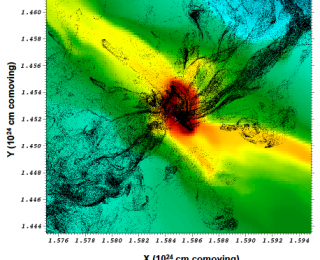
What if the first stars were only 1-50 times as massive as the Sun? Would they still be able to enrich the intergalactic medium and trigger the birth of the next generation of stars?
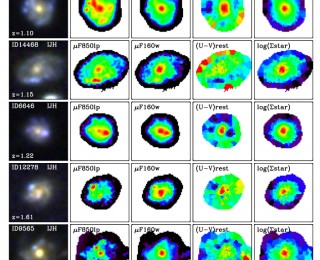
The lack of observed major mergers at high-redshift has prompted discussion of inside-out growth, that is, galaxies building up their stellar populations by cold gas accretion, starting in the inner regions and gradually moving outwards. This picture is far from settled, however, and so the authors of this paper set out to investigate whether or not the observations match the theory.
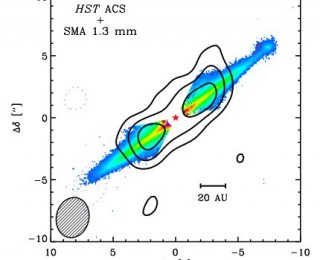
AU Mic is a low mass star that undergoes unpredictable brightening events, called flares. It’s located just 10pc and has a circumstellar disk. In this paper, Wilner et al. report on observations of the disk at millimeter wavelengths and find evidence for a planetesimal ring.
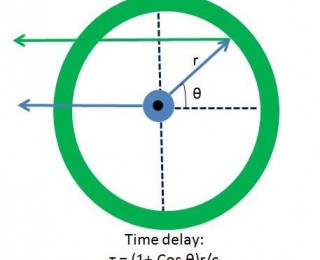
Doroshenko et al. use extensive monitoring of the continuum and broad line region luminosities of Markarian 6 to measure the central black hole mass.
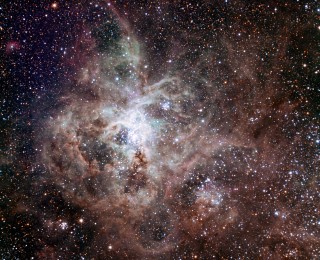
This paper discusses the propagation characteristics of cosmic-ray electrons and nuclei in 30 Doradus as well as the Large Magellanic Cloud. Two major correlations are found. For 30 Doradus there is a correlation between the radio and infrared emission. For the LMC there is a link between the cosmic ray electron propagation length with the star formation rate.