by Anna Rosen | Mar 27, 2012 | Daily Paper Summaries
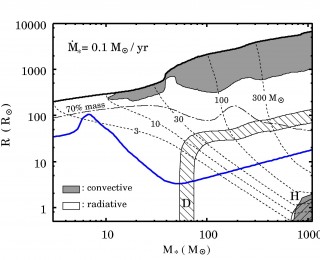
Could stars with masses 100,000 times more massive than our Sun exist? Are these the possible progenitors for supermassive black holes that litter our universe today?

by Ryan Foltz | Mar 27, 2012 | Daily Paper Summaries
How do we locate galaxy clusters in the sky? We’ll examine the red sequence method in particular.
by Nathan Goldbaum | Mar 24, 2012 | Daily Paper Summaries
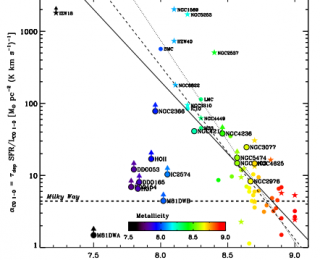
It’s an unpleasant fact of galactic astrophysics that most of the molecular gas in nearby galaxies is completely undetectable.
by Dan Gifford | Mar 23, 2012 | Daily Paper Summaries
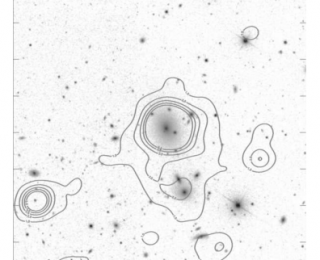
Title: The XMM Cluster Survey: The Stellar Mass Assembly of Fossil GalaxiesFirst Author: Craig D. HarrisonFirst Author Institution: University of MichiganHow do you describe a fossil? Old? Imprinted? Dead? Pristine? A link to the past? As it turns out, the word fossil has been used to describe a distinct population of galaxies and systems of galaxies in our universe. Hierarchical structure formation models indicate that small things build larger things over cosmic time. When groups and clusters of galaxies form, dynamical friction causes the galaxies to lose momentum and kinetic energy, which can ultimately lead galaxies to merge. This dynamical friction has the greatest effect in high density regions, which causes mergers to create a large brightest cluster galaxy (BCG) at the center of these systems. Observations have identified a population of clusters that have a very large BCG, but not very many bright companions (ie, a magnitude gap exists) and called these Fossil Galaxies in Fossil Systems. The use of word fossil here is perfect because the BCG appears to live in a “dead” or depleted environment, and the entire merger history should be imprinted in its stellar population.So what can we learn from these fossil systems? Because of small samples, much of what we already know has come from simulations. These simulations indicate that fossil systems gain a large fraction of their mass at high redshift and earlier than non-fossil groups. One hypothesis is that growth of fossils was dominated early by in-fall of massive satellites which boosted the size of the fossil galaxy relative to its cousins in non-fossil systems, which evolved slightly more passively. Another...
by Evan Schneider | Mar 20, 2012 | Daily Paper Summaries
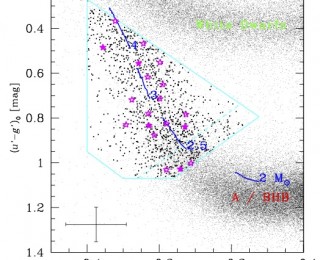
Five new hypervelocity stars have been discovered in the outer regions of the Milky Way. In this paper, the authors discuss what these stars are, how they got so far away, and what their distribution implies about the center of our galaxy.
by Nick Hand | Mar 17, 2012 | Daily Paper Summaries
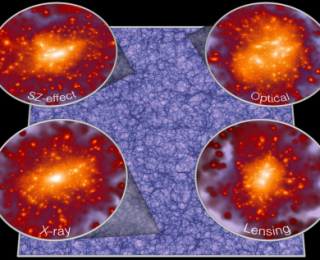
The authors of this analysis use the largest, high-resolution cosmological N-body simulation to date, the Millennium-XXL, to investigate sources of scatter in cluster scaling relations. They find that a wide range of biases can affect the most commonly used scaling relations.
