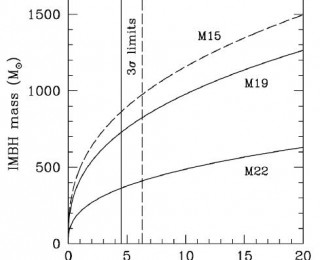
Intermediate mass black holes: the elusive middle sibling
Strader et al. search for the elusive intermediate mass black holes in globular clusters.

Strader et al. search for the elusive intermediate mass black holes in globular clusters.
This paper demonstrates a brand new method of calculating Hubble’s Constant using the luminosity of HII galaxies.
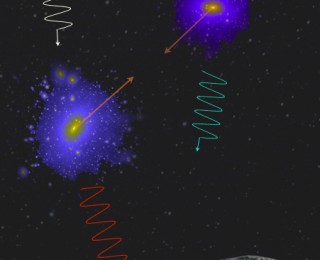
Astronomers present the first-ever detection of the motion of distant galaxy clusters via an effect first theorized 40 years ago.
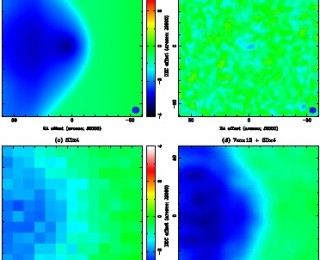
In order to prepare for ALMA observations, these authors make mock-observations of simulated data, and they show that ALMA will be an ideal observatory for studying galaxy clusters using the SZ effect.
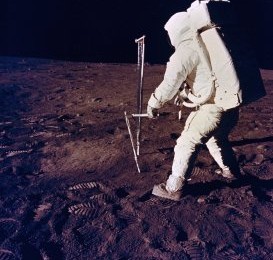
Are robotic missions really more efficient than human space exploration? Ian Crawford explains why planetary astronomers should support human space exploration.
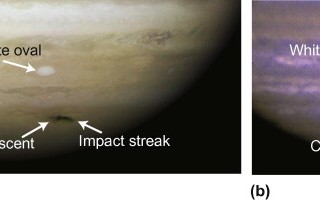
The impact of comet Shoemaker-Levy 9 was a remarkable event: in 1994, a comet, torn into pieces during a close approach with Jupiter two years prior, crashed into Jupiter. It was the first collision between two solar system bodies to ever be observed, and the effects on Jupiter’s atmosphere (see the figure below) were visible for months. At the time, Harrington et al. (2004) predicted that it would be hundreds of years before such an event occurred again. But two and a half years ago, another object collided with Jupiter. No one witnessed the collision, but amateur astronomer A. Wesley noticed a dark streak with properties closely matching those seen after the impact of SL-9. Because of these similarities, it is believed that this feature was the result of an impact.