This post no longer exists.
This post has been removed. Please see the Astrobites Statement on Harassment Case at Leiden University for more details about this removal.

This post has been removed. Please see the Astrobites Statement on Harassment Case at Leiden University for more details about this removal.
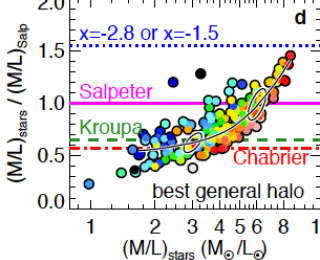
The basis for something called the “G dwarf problem” is the comparison between observations and a simple model for chemical evolution in a galaxy. To cut to the chase, there are fewer very metal poor G dwarfs than are predicted by this basic understanding. This discrepancy has been shown to hold for the Milky Way as well as for other galaxies. It also holds for K dwarfs in the Milky Way – and now for M dwarfs as well.
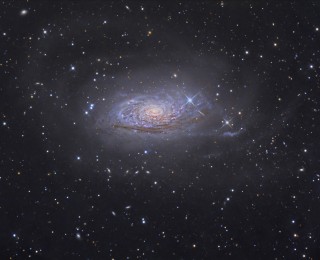
A picture of galaxy construction emerges by comparing the relative sizes of star-formation and stellar continuum emission from 57 z=1 galaxies.
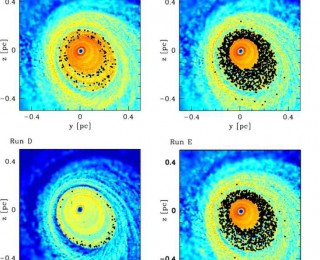
The Center of our Galaxy is one of the most extreme dynamical environments we can observe in detail because individual stars can actually be resolved using adaptive optics. Over time, monitoring individual stellar orbits has firmly established the presence of a supermassive black hole of about 4 x 10⁶ M☉ (check out this video too). Further examination of these fast-moving stars’ properties (via infrared spectroscopy) revealed a surprising detail — many of these stars are young!
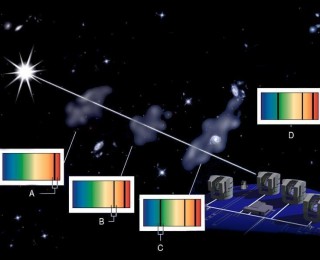
When the light from a distant quasar finally arrives at Earth, it often carries far more information than it did when it was emitted – the shadows of gas and galaxies that have intervened over the cosmic distances between us and the source. These features can tell us how the universe evolves in both space and time, by allowing us to sample both low and high redshifts for structures that would not otherwise be visible. This paper uses a new IR spectrograph, FIRE, deployed on the Magellan 6.5 m telescopes, to present the first high-redshift sample of Mg II absorption systems, including the most distant Mg II system yet found (z = 5.33). The authors show that the number of strong Mg II systems appears to peak and decline in number along with the star formation history of the universe, suggesting a correlation between the two, while weak Mg II systems stay mysteriously constant.
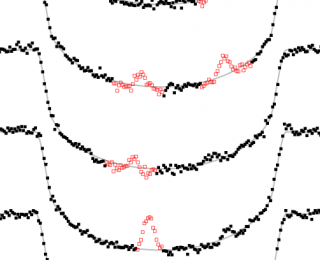
This paper discusses the observed anomalies caused by starspot occultations due to transiting exoplanets. They are useful in determining the obliquity of the star with respect to the orbital plane of the transiting planet.