by Susanna Kohler | Feb 10, 2012 | Daily Paper Summaries
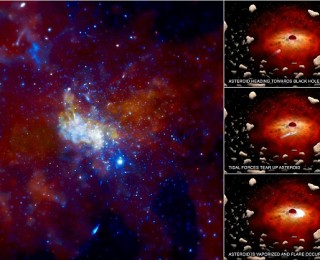
Small daily flares are observed from the black hole in the center of our galaxy. The authors of this paper propose the flares are due to Sgr A* frequently snacking on asteroids!
by Ian Czekala | Feb 10, 2012 | Daily Paper Summaries
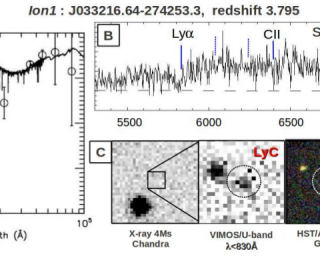
Any photon with a wavelength shorter than 912 angstroms (the Lyman limit) will ionize neutral hydrogen by raising the atom’s electron from the ground state to an unbound state at infinity. From measurements of quasar absorption spectra, we know that the reionization of the intergalactic medium from its previously neutral state (at redshifts greater than 7) to the highly ionized state we observe today was complete by redshift of ~7. However, we still do not know which sources were responsible for producing the ionizing photons.
by Allison Strom | Feb 10, 2012 | Daily Paper Summaries
Using the unique chemical composition found in every star’s atmosphere, the authors identify potential members of a dissolved star cluster in the Sextans dwarf spheroidal galaxy and investigate the origin of dwarf galaxies in the Milky Way halo.
by Sukrit Ranjan | Feb 9, 2012 | Daily Paper Summaries
• Paper title: One Or More Bound Planets Per Milky Way Star From Microlensing Observations (arXiv: 1202.0903) • Authors: Arnaud Cassan et al • First Author’s Affiliation: Institut d’Astrophysique de Paris, Paris, France.• Journal: NatureIntroduction and MotivationThe objective of this paper was to determine the distribution of planets across the entire galaxy, broken down by mass and semimajor axis, from microlensing data. Previous surveys have focused on data from the Doppler (radial velocity) and transit methods, which are both biased to preferentially detect hot, close-in planets. Microlensing, in contrast, is ideally suited for finding cool planets far from their host stars.Figure 1 illustrates the microlensing technique, which depends on the use of a foreground lensing object’s gravity to magnify the light of a background object. When one star (the “lens”) passes in front of another, gravitational lensing amplifies the background star’s light. If this foreground star is orbited by another object (such as a planet), and the object intersects the star’s Einstein ring, its gravity causes an additional spike in the measured intensity from the background object. The duration of lensing events can range from minutes to days, and provides constraints on a planet’s mass, semimajor axis, and period. While these events require precise alignment of two stars, and thus are infrequent, the incredible wealth of information gleaned from them – and their ability to find planets further from their host stars than the transit and radial velocity methods can – makes microlensing an indispensable technique for the planet hunter. Methods and ResultsThe authors studied the detection rates from the PLANETS microlensing survey from 2002-2007, and then extrapolated the survey’s...
by Maria Drout | Feb 8, 2012 | Daily Paper Summaries
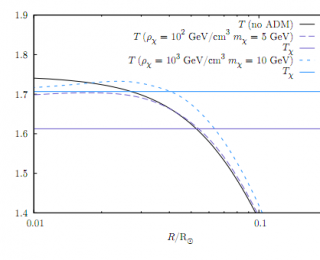
What happens to the structure and properties of a star in a the presence of dark matter?
by Lucia Morganti | Feb 7, 2012 | Daily Paper Summaries
Dark matter profiles of dwarf galaxies in high resolution hydrodynamical simulations are compared with observations. A physically motivated energy feedback from Supernovae generates gas outflows which are able to remove efficiently large fraction of gas from the inner regions of the galaxies, thus forming central cores and alleviating the “core-cusp problem”.
