by Justin Vasel | Feb 4, 2012 | Daily Paper Summaries
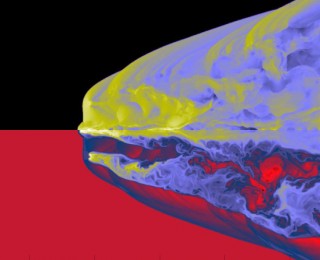
This paper considers the fate of red giants and clouds of dark gas that wander in front of the relativistic jets within AGN. Numerical simulations are performed under varying jet conditions for obstacles of homogeneous and inhomogeneous composition.

by Adele Plunkett | Feb 3, 2012 | Daily Paper Summaries
Title: Line profiles of cores within clusters: I. The anatomy of a filament Authors: Rowan J. Smith, Rahul Shetty, Amelia M. Stutz, Ralf S. Klessen First Author’s Institution: Centre for Astronomy at the University of Heidelberg, GermanyStars are a fundamental component of the universe, building blocks of larger structures like galaxies and galaxy clusters. The cycle of star formation, evolution, death and rebirth, recycling on cosmic scales, is interesting but difficult to observe at all stages. Within our lifetimes, we can’t observe one star as it progresses through a complete life-cycle, but we can observe a variety of stars at a variety of evolutionary stages in order to tell the whole story. However, it remains a challenge to observe stars in the earliest stages as they are forming. Stars form in dense environments obscured by cold dusty material. One tool for identifying star-forming cores (this is the terminology used when a cloud of molecular gas has collapsed and begins to form a star) is the observed blue infall asymmetry. Let me explain.When you (the observer) stare straight into a (spherical) core as it collapses, you will see some gas on the near side of the cloud moving away from you and some gas on the far side of the cloud moving towards you. Remember, you only see a 2-D picture, and using the doppler shifting of light, you will only measure the velocity component projected along the line of sight. Along any line of sight, there will be two elements of gas with similar line-of-sight velocity components. However, considering that the gas is dense enough and becomes opaque at...
by Courtney Dressing | Feb 2, 2012 | Daily Paper Summaries
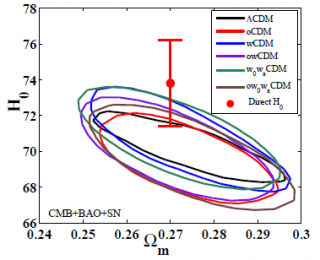
In this series of papers, the authors apply new analysis techniques to data from several galaxy redshift surveys to uncover acoustic waves from the early universe and refine measurements of cosmological parameters.
by Elisabeth Newton | Feb 1, 2012 | Daily Paper Summaries
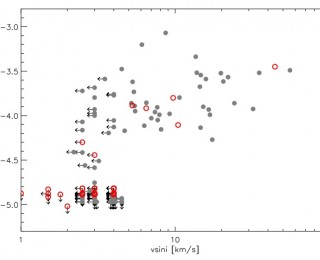
This paper delves into some of the physical properties of early M dwarfs (M0-M4.5), focusing on chromospheric/magnetic activity and rotation. The authors present a catalog of activity and rotation for 334 early M dwarfs.
by Caroline Morley | Feb 1, 2012 | Daily Paper Summaries
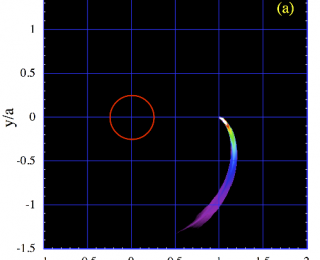
A very small rocky planet—close to the size of Mercury—is evaporating as it orbits the host star. The putative planet orbits the star in less than 16 hours, so the planet’s surface is highly irradiated. The planet would actually be hot enough to vaporize rocky material at the surface, which could escape the gravitational pull of the planet and form a comet-like tail trailing the orbit.
by Kirit Karkare | Jan 31, 2012 | Daily Paper Summaries
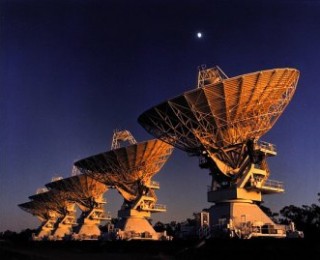
Using a rotational transition of methanol, this paper attempts to see if a fundamental constant has changed over cosmic time.
