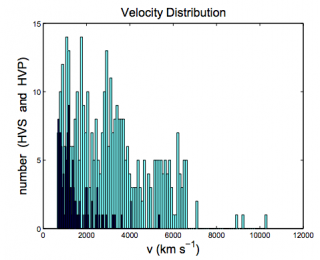
by Lauren Weiss | Feb 22, 2012 | Daily Paper Summaries
Don’t wish upon a shooting star; wish upon a shooting planet.
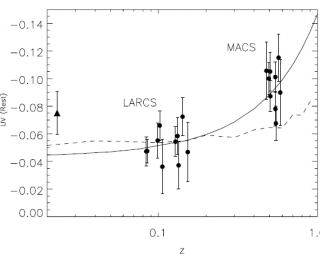
by Ryan Foltz | Feb 21, 2012 | Daily Paper Summaries
Title: The Evolution of the Red Sequence Slope in Massive Galaxy Clusters Authors: J. P. Stott, K. A. Pimbblet, A. C. Edge, G. P. Smith, J. L. Wardlow First Author’s Institution: Astrophysics Research Institute, Liverpool John Moores UniversityIn this post, we’ll examine a recent paper on the ongoing and controversial investigation into the evolution of the galactic color-magnitude relation. The color-magnitude relation is a phenomenon specific to galaxies in clusters, and I’ve written a post on the subject before. Studying the time evolution of this relationship is a powerful means with which to probe galaxy evolution, which means it can provide us with a picture of how structure formed in our universe.The Color-Magnitude RelationWe’ve known about the color-magnitude relation in some capacity since the 1950s. De Vaucouleurs noticed the effect in 1961 during his study of morphology in the Virgo cluster, and before him Stebbins and Whitford had found suggestive results in a handful of their galaxies. However, it wasn’t until Bower’s work in 1992 that the relation was conclusively demonstrated.So what is it? To put it simply, the color-magnitude relation just means that an elliptical or lenticular galaxy of a certain redness in a cluster will have a certain absolute magnitude, or brightness. A bluer galaxy is fainter. There are several things to note about the phenomenon:For one, the relation isn’t so exact that the galaxy must have the indicated magnitude, but Bower demonstrated that the relationship was in fact very good, with intrinsic scatter on the order of a few hundredths of magnitude for his sample. In fact, since we can determine a galaxy’s absolute magnitude to such precision, we can...
by Nathan Goldbaum | Feb 21, 2012 | Daily Paper Summaries
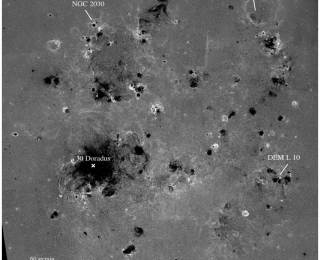
Title: The Optical Depth of H II regions in The Magellanic Clouds Authors: E. W. Pellegrini, M. S. Oey, P. F. Winkler, S. D. Points, R. C. Smith First Author’s Institution: Department of Astronomy, University of MichiganIt’s a common theme on astrobites that massive stars play a far more important role in galaxy evolution than one might casually assume based on their numbers alone. One of the main reasons massive stars are so important is their copious production of radiation that can ionize hydrogen gas. These energetic photons can photoionize and photodissociate atomic and molecular gas, creating hot, ionized gas that will not collapse to form new generations of stars. The hot, overpressured gas created by ionization, which astronomers refer to as an H II region, drives an ionization front capable of sweeping up and stirring gas throughout a star forming region. For particularly massive star clusters, which may contain hundreds or thousands of massive stars, the ionized region surrounding the central cluster, can extend for many hundreds of parsecs, visible to us as beautiful nebulae, like the 30 doradus star forming region in the Large Magellanic Cloud (at right). Massive clusters can also directly ionize intergalactic space, producing the diffuse ionized IGM that we know has been in place since the universe was about a billion years old. Today’s astrobite takes a close look at our nearest galactic neighbors, using a novel technique to infer the state of ionized gas and ionizing photons the Magellanic Clouds.Pellegrini and collaborators make use of imaging of the Magellanic clouds in narrowband filters centered on two emission lines of oxygen and sulfur. These particular emission lines are produced when...
by Nathan Sanders | Feb 20, 2012 | Daily Paper Summaries
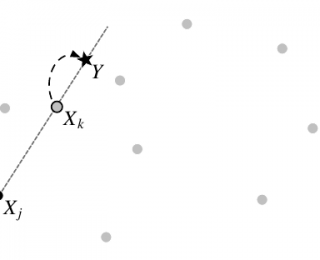
What’s the best way to sample a banana? A new code implements an efficient solution to this and other Bayesian inference problems.
by Nick Hand | Feb 18, 2012 | Daily Paper Summaries
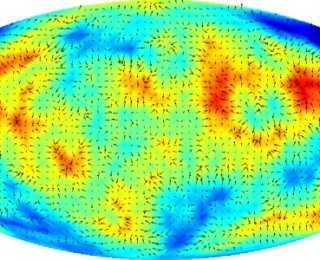
The South Pole Telescope collaboration detects the effects of gravitational lensing on the cosmic microwave background and derives improved constraints on several cosmological parameters.
by Alice Olmstead | Feb 16, 2012 | Daily Paper Summaries
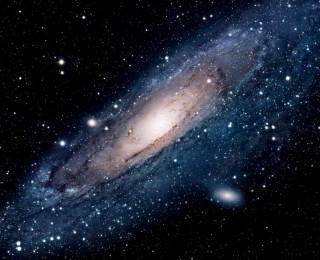
A specific class of elliptical galaxies called compact ellipticals, or cEs, are unusually compressed. Some speculate that these galaxies are petite because their outer layers have been stripped away by a neighboring galaxy; however, an alternative theory claims that these are regular elliptical galaxies that simply formed small and never contained stars in their outer regions. In order to differentiate between these two models, Howley et al. 2012 measured the dynamics of individual stars in one of our nearest neighbors, the compact elliptical M32.
