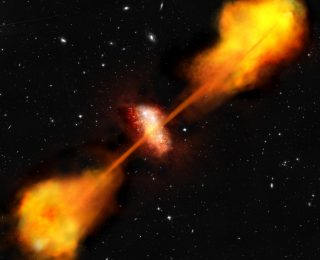
Is the Fault in their Stars?
Identifying the incidence of AGN as a function of star formation rate

Identifying the incidence of AGN as a function of star formation rate
Professor Elisabeth Mills studies one of the most mysterious regions of the Milky Way: the galactic center. Learn about the stars, gas, and a black hole that make this such an exciting area of research ahead of her talk at #AAS234.
A novel approach to estimate their mass may help reveal the relationship between supermassive black holes and the galaxies they inhabit.
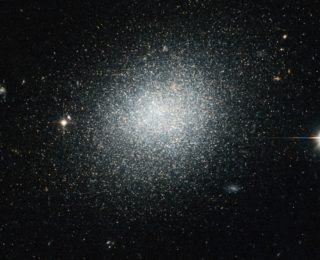
Could feedback from active galactic nuclei play an important role in the smallest of galaxies?
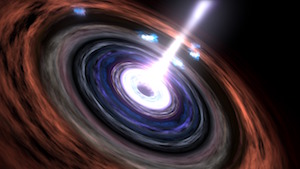
The redshifts of active galactic nuclei (AGNs) can help us piece together the universe’s evolutionary timeline. Unfortunately, measuring these redshifts can be pretty tricky. In today’s astrobite, we look at a trick for estimating and constraining the redshifts of AGNs that are – ironically enough – partially obscured from our view.

Some galaxies live peaceful lives, calmly making stars at a sedate pace, with supermassive black holes that don’t vomit jets of material. Other galaxies… not so much. Come to Professor Julie Comerford’s upcoming #AAS232 talk to learn more about the weird and wonderful world of active galactic nuclei!