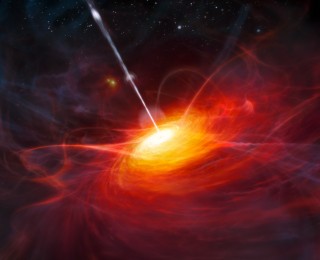
Dust-Rich Quasars at z~1.5
How does AGN activity influence star formation in active galaxies? Dai et al. combine multi-wavelength observations of 32 quasars to bring us closer to the answer.

How does AGN activity influence star formation in active galaxies? Dai et al. combine multi-wavelength observations of 32 quasars to bring us closer to the answer.
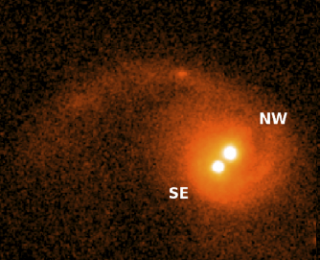
It has long been known that galaxies can merge; thus, we should expect their central supermassive black holes to interact as well. However, our ability to study this is limited as most mergers happen in the distant universe. The exceptional nearby source CID-42 can be explained by a recent binary or triple supermassive black hole interaction, giving astronomers a rare chance to witness the repercussions of such an event.
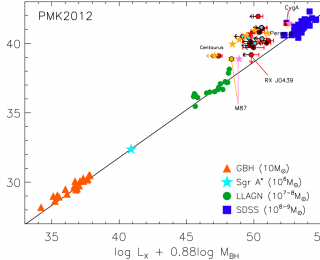
A team of astronomers at the University of Cambridge have uncovered evidence for ultramassive black holes in the giant elliptical galaxies that sit at the center of galaxy clusters. These whoppers could be up to ten times more massive than ordinary supermassive black holes, like the ones we usually find in centers of galaxies.
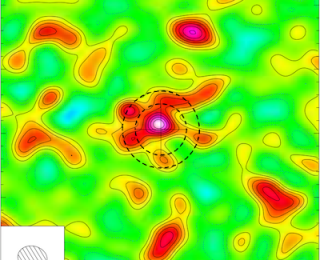
The idea of “negative feedback” on star formation in galaxies is ubiquitous, but the debate about what causes the massive outflows we see in galaxies is far from over. Now, Maiolino et al. have found evidence of a massive quasar-driven outflow at z > 6, making it the earliest instance yet of a central black hole affecting its host galaxy on a global scale.
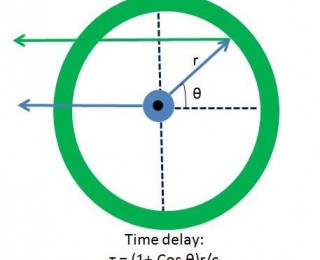
Doroshenko et al. use extensive monitoring of the continuum and broad line region luminosities of Markarian 6 to measure the central black hole mass.
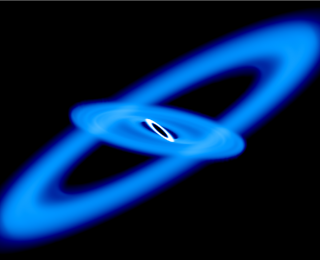
How fast can you grow a supermassive black hole by accretion? That depends on how much you tilt the disk…