by Justin Vasel | Feb 4, 2012 | Daily Paper Summaries
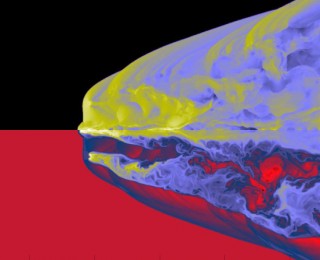
This paper considers the fate of red giants and clouds of dark gas that wander in front of the relativistic jets within AGN. Numerical simulations are performed under varying jet conditions for obstacles of homogeneous and inhomogeneous composition.

by Guest | Jan 8, 2012 | Career Navigation
Kevin Schawinski of Yale University, co-founder of the Galaxy Zoo project, explains how to use crowd sourcing to make sense of enormous data sets.
by Allison Strom | Dec 16, 2011 | Daily Paper Summaries
Conference proceedings from the 2011 Fermi Symposium highlight some of the major science applications of the gamma-ray space observatory.
by Allison Strom | Nov 18, 2011 | Daily Paper Summaries
Modica et al. and the GOALS team use multiwavelength observations to investigate star formation and nuclear activity in a nearby luminous infrared galaxy.

by Courtney Dressing | Nov 10, 2011 | Daily Paper Summaries
Paper title: Bars rejuvenating bulges? Evidence from stellar population analysis Authors: Paula Coelho and Dimitri A. Gadotti First author’s affiliation:Núcleo de Astrofísica Teórica, Universidade Cruzeiro do Sul, São Paulo, Brasil SummaryAs you may recall from Nathan Sanders’ April post, some spiral galaxies have central bulges with high concentrations of stars. Coelho and Gadotti examine a sample of 575 of these galaxies to investigate whether the presence or absence of a bar (a bar-shaped overdensity of stars) influences the rate of star formation in the central bulge. Astronomers expect to see a higher star formation rate in the bulges of barred galaxies because bars can transport gas from the outer regions of the galaxy into the center and supply fuel for growing stars. Previous detections of star-formation indicators (such as enhanced Hα emission) have indicated that the current star formation rates are higher in barred spirals than in unbarred spirals, but Coelho and Gadotti take the alternative approach of determining the ages of the stellar populations in the bulges. They find that the bulges of barred galaxies are systematically younger than the bulges of unbarred galaxies, which is consistent with the expectation that bars should promote star formation. The Galaxy SampleIn a previous paper, Gadotti derived stellar masses, bulge stellar masses, bar properties, and other parameters for a sample of face-on galaxies observed by Sloan Digital Sky Survey (SDSS). All of the galaxies had stellar masses above 10^10 solar masses and redshifts between 0.02 and 0.07. Selecting face-on galaxies reduced the effect of dust and simplified the process of identifying bars and bulges in the galaxies. In this paper, Coelho...
by Susanna Kohler | Nov 4, 2011 | Daily Paper Summaries
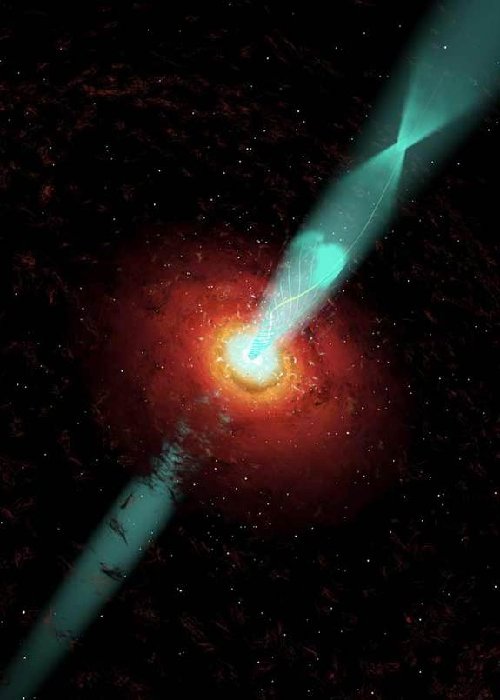
We think that blazars and gamma-ray bursts are both powered by extremely relativistic jets — but how is the kinetic energy of these jets transformed into the staggering amounts of radiation we observe?
