by Alice Olmstead | Nov 25, 2012 | Guides, Personal Experiences
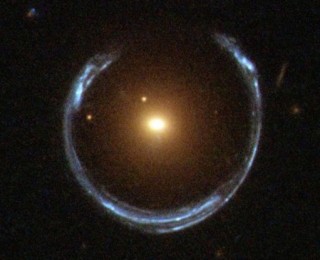
I recently attended a two-week crash course in the “Astrophysical Applications of Gravitational Lensing”. In this post, I overview a few of the ways astronomers employ lensing to study the Universe, from extrasolar planets to distant quasars and large-scale structure.
by Kim Phifer | Nov 6, 2012 | Daily Paper Summaries
Rafferty et al. study the effect of radio jets on the intracluster gas in Hickson Compact Group 62.
by Shannon Hall | Sep 16, 2012 | Daily Paper Summaries
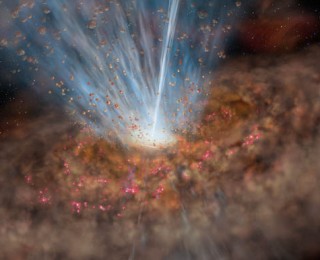
In the nearby Universe, massive galaxies contain very little interstellar gas and old stellar populations. But theoretical models predict that such galaxies should have much younger stellar populations. In order to solve this discrepancy models invoke quasar outflows in the early Universe. Such outflows would expel the gas from a galaxy and quench star formation. Presented here are the results from the first massive quasar outflow observer at z ~ 6.4189.
by Kirit Karkare | Sep 11, 2012 | Daily Paper Summaries
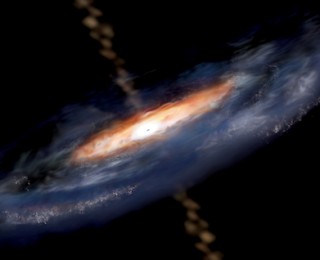
Active galactic nuclei are some of the most luminous objects in the universe. This paper explores how feedback from AGN could trigger star formation in their host galaxies.
by Alice Olmstead | Jul 31, 2012 | Daily Paper Summaries
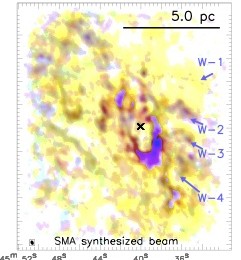
Recent studies have revealed a surprising amount of activity happening in the heart of our own Milky Way. In this paper, Liu et al. explore the kinematics of the gas outside the most central regions of our galaxy, and reveal that the Galactic center is being fed even more material from the main structure of the Milky Way.
by Evan Schneider | May 16, 2012 | Daily Paper Summaries
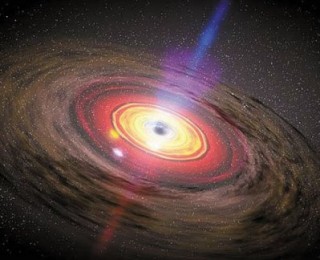
We know that supermassive black holes exist, but how did they get so big? In this paper, the authors seek to shed some light on their progenitors – rapidly accreting, intermediate-mass black holes.
