
What’s Next For Kepler?
NASA is looking for a new mission for the damaged Kepler space telescope. Here are some ideas.

NASA is looking for a new mission for the damaged Kepler space telescope. Here are some ideas.
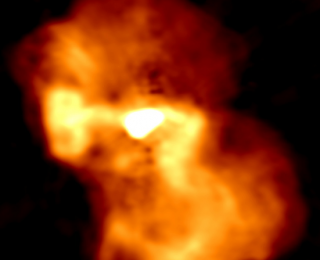
Check out these cool new results from LOFAR which is boldly going to some of the longest wavelengths astronomers have ever observed! An active galaxy has a less active past than we might expect, pulsating neutron stars are behaving strangely, and even at wavelengths as long as meters, there are still spectral lines from extremely low-energy atomic transitions.
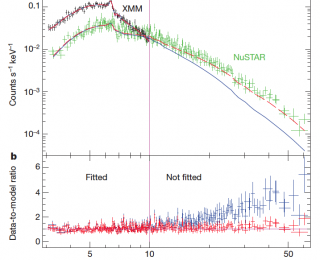
Previous authors have claimed that the black hole at the center of NGC 1365 is spinning extremely rapidly. But these claims are based on certain assumptions about the dominance of relativistic effects on the spectrum of NGC 1365. Risaliti et al., dig deeper into the spectral data of this X-ray source and use simulations to determine whether the signatures we see are caused by a rapidly-spinning black hole, or just cloudy (galactic) weather.
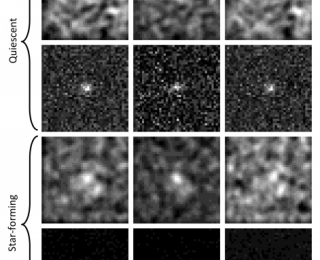
The authors investigate the fraction of massive galaxies at z ~ 2 that contains an Active Galactic Nucleus (AGN), in hopes of understanding the importance of AGN in quenching star formation.
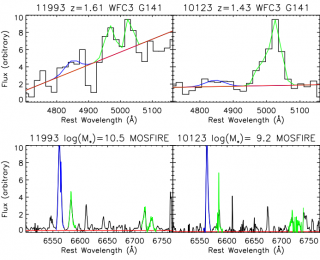
Using new data from the MOSFIRE spectrograph, the authors of this paper test the ability of classic emission line diagnostics to separate star formation activity from supermassive black hole accretion at high redshift. What they find may be important for understanding how the growth galaxies and black holes affect one another over cosmic time.
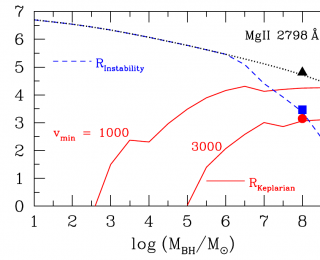
Observational surveys looking for the smallest super-massive black holes come up empty; could they be hiding in plain sight?