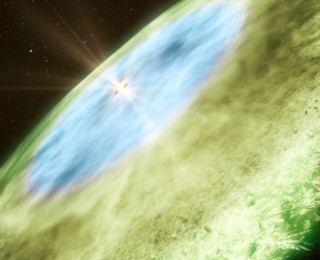
Imaging a CO snow line with ALMA
Astronomers imaged a snow line in a protoplanetary disk with ALMA – a step towards a better understanding of the theory of planet formation.

Astronomers imaged a snow line in a protoplanetary disk with ALMA – a step towards a better understanding of the theory of planet formation.
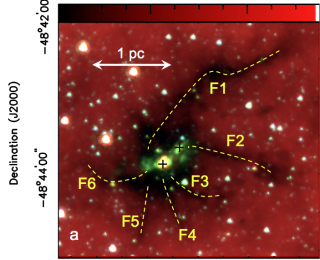
The formation of massive stars is still an intense topic of debate. Observations are difficult because massive star forming regions are heavily obscured by dust – invisible in the optical and near infrared. The trick is to look at much longer wavelengths. Today’s paper does just that, using the Atacama Large Millimeter Array (ALMA) in Chile to observe the birth of a massive star in submillimeter wavelengths. At 500 times the mass of the Sun and 1 million times brighter, it is the largest forming protostar ever seen in our galaxy.
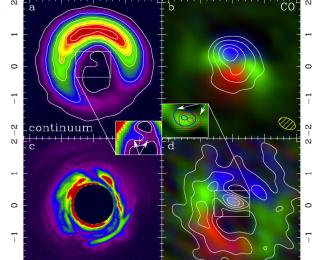
There’s a lot going on in the HD 142527 protoplanetary disk — accretion, gap opening, and a horseshoe-shaped dust ring. The authors of this paper used ALMA to take a closer look at the gas and dust in this busy disk.
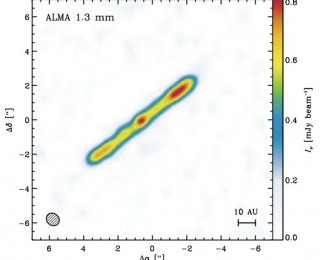
I’ve got pretty bad eyesight. If I take off my glasses and look at the flowers on my window sill, they look like a fuzzy yellow blob. But with glasses, the petals and the patterns cast on them come into focus. This is how I felt when looking at the new observations of the debris disk around AU Mic. Putting on our ALMA glasses, the fuzzy debris disk around AU Mic is sharpening into something surprisingly consistent with our own Solar System.
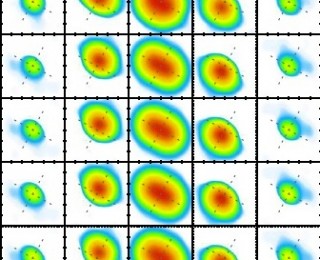
Amid all of the swirling chaos during star formation, the universe finds a way to order its diffuse gas into shining young stars. ALMA Science Verification observations give new insight.
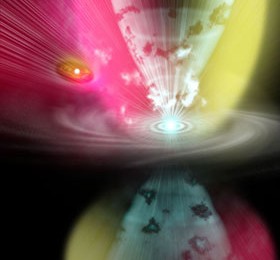
Molecular outflows are important components of the star formation process. These authors present observations of a butterfly-shaped outflow in Orion, and present several possible scenarios for this morphology.