by David Wilson | Sep 28, 2015 | Daily Paper Summaries
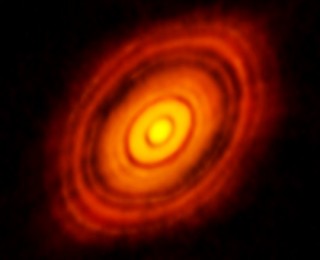
Nearly a year ago, the ALMA collaboration released this stunning image of the young star HL Tau. The sub-millimeter wavelengths of light that ALMA detects revealed a vast disc of gas and dust, several times larger than Neptune’s orbit. Intriguingly, the disc was divided up into a series of well-defined, concentric rings.
The cause of the rings seemed clear: There must be planets around HL Tau, their gravity sculpting the gas and sweeping out the dark gaps in the disc.
by Jesse Feddersen | Aug 19, 2015 | Daily Paper Summaries
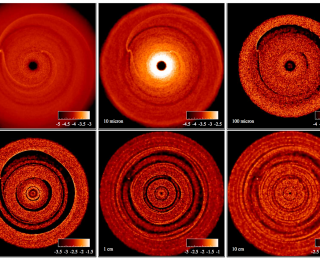
Last year, an image was released that took our breath away. Exquisite rings carved in a disk of material around a nearby star. Now, astronomers want to know if forming planets are responsible, and why the image might look different from the cartoon in your textbook.
by Jesse Feddersen | Jun 29, 2015 | Daily Paper Summaries
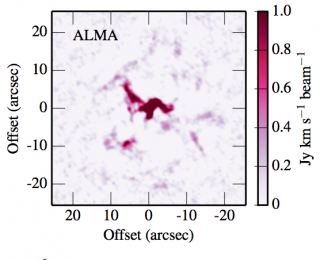
Low-mass stars are much more common than massive ones. But massive stars outshine the smaller ones a thousand to one! How can astronomers account for this hidden majority? Maybe alcohol will help…
by Ben Cook | May 13, 2015 | Daily Paper Summaries
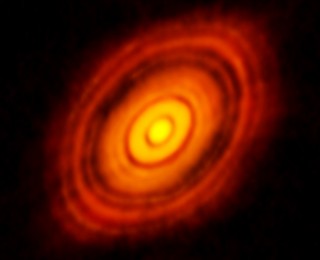
The authors of today’s paper show that the locations of the protoplanetary gaps in HL Tau are to be expected from the condensation points of common ices in the disk.
by Tim Lichtenberg | Feb 6, 2015 | Daily Paper Summaries
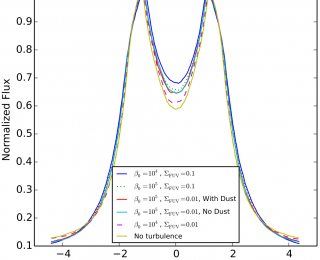
Why do planetary disks fade away so fast? A leading candidate as villain in this story is turbulence. Using the combined strengths of sophisticated theoretical models and observations, we might be able to find out if this is true!
by Elisa Chisari | Oct 16, 2013 | Daily Paper Summaries
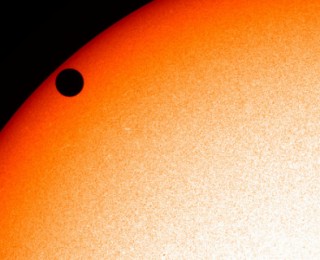
We are used to thinking about planet transits in visible wavelengths. What can we learn from planet transits in the radio band? Today, we discuss what these transits might tell us about the magnetic activity and the atmosphere of a star.
