Observing the Velocity Anisotropy of Cluster Galaxies

Observing the Velocity Anisotropy of Cluster Galaxies

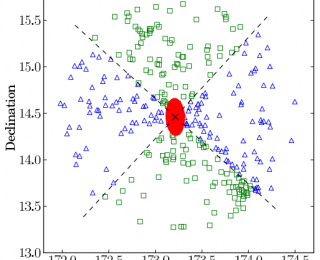
Title: Spatial Anisotropy of Galaxy Kinematics in Sloan Digital Sky Survey Galaxy ClustersFirst Author: Skielboe, A.Galaxy clusters are beautifully simple, but also fantastically complicated structures. For many years, astronomers have treated these systems as spherical cows, but simulations and observations have repeatedly shown that clusters exhibit triaxial rather than spherical shapes with nice relaxed dynamics (are virialized). Many cluster mass estimators assume spherically symmetric velocity fields (i.e. you measure the same velocities of cluster galaxies regardless of which side you observe from), but if the shape is anisotropic it’s probable the velocities are as well. This makes it crucial to measure the degree of triaxiality of clusters in observations to constrain its impact on mass estimates.The authors sought to show that velocity anisotropy exists by testing for an azimuthal (angle on the sky) dependence of the projected velocity dispersion. To do this, they used a stacked sample of galaxy clusters from the Sloan Digital Sky Survey (SDSS). Stacking is a common technique of taking many clusters with a similar property (in this case galaxy richness or number which is a proxy for mass) and adding them together to make a composite system with many hundreds more galaxies than any one system alone. This gives much better statistics and makes a result more robust.Because the authors are looking for azimuthal variations, they fit each cluster with an ellipse and stack them with their major axes aligned. They then estimate the projected velocity dispersion for galaxies closer to the stacked minor axis, and a separate velocity dispersion for galaxies closer to the major axis. Because they have a stacked sample with...
Astronomers like Easter egg hunts: studying a unique star system in the infrared

Astronomers like Easter egg hunts: studying a unique star system in the infrared

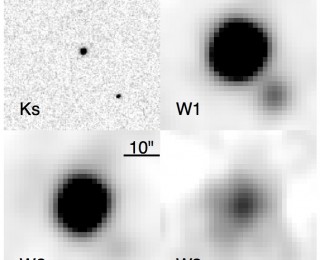
Astronomers like to find cool things. The first Earth-sized planet. The most distant galaxy yet. Two stars that merged while we watched. The coolness factor is certainly one reason why we keep at it – who wouldn’t want to be the first to find an Earth-sized planet, or the first human to see light from a galaxy that’s existed for billions of years? But there’s also a compelling scientific reason to search for these oddballs. This paper reports on the likely discovery of dust around a pair of binary stars.
Spinning the First Stars

Spinning the First Stars

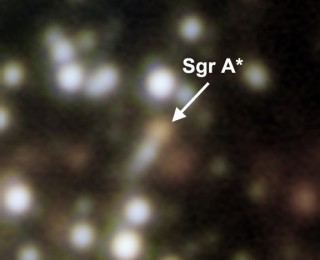
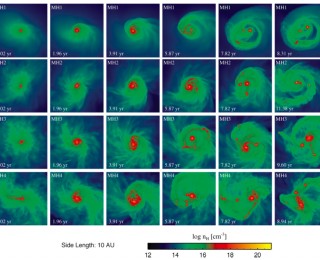
In a recent paper, Stacy et al. reveal the detailed internal structure of the seeds of four of the first stars, and demonstrate for the first time that they are rapidly spinning throughout. Their results bring us one step closer to a coherent story of the lives and deaths of Population III stars.
Astrophysical Classics: Predicting Tidal Heating of Io

Astrophysical Classics: Predicting Tidal Heating of Io

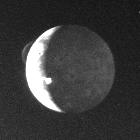
It’s March 2, 1979. Two years ago, the Voyager spacecraft were launched on trajectories that will allow them to carry out their primary missions: the study of the outer Solar System, in particular Jupiter and Saturn. It’s just three days before Voyager 1’s closest approach to Jupiter. The paper that was published on March 2nd, 1979 in Science is a prediction for what the Voyager spacecraft might see on Io based on the orbital motions of these three satellites.