by Alice Olmstead | Jan 22, 2013 | Daily Paper Summaries
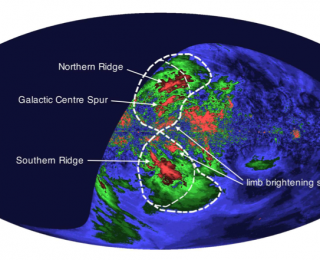
Carretti and collaborators have found new evidence that the gigantic bubbles of emission emanating from the center of our Milky Way are the result of winds from supernova explosions, not jets from our supermassive black hole.
by Alice Olmstead | Dec 30, 2012 | Daily Paper Summaries
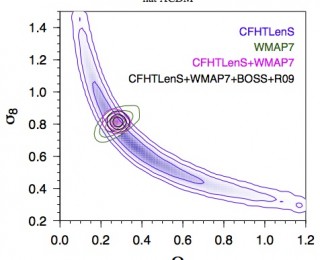
The Canada-France Hawaii Telescope weak gravitational lensing survey (CFHTLens), recently released new results to help constrain our cosmological models. While still in its early stages, weak lensing will ultimately be a powerful tool to discover the nature of the mysterious dark energy.
by Elisabeth Newton | Dec 11, 2012 | Daily Paper Summaries
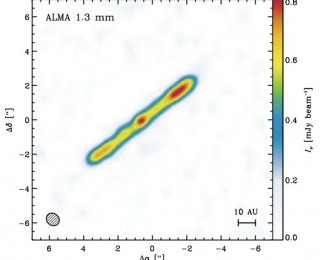
I’ve got pretty bad eyesight. If I take off my glasses and look at the flowers on my window sill, they look like a fuzzy yellow blob. But with glasses, the petals and the patterns cast on them come into focus. This is how I felt when looking at the new observations of the debris disk around AU Mic. Putting on our ALMA glasses, the fuzzy debris disk around AU Mic is sharpening into something surprisingly consistent with our own Solar System.
by Alice Olmstead | Nov 25, 2012 | Guides, Personal Experiences
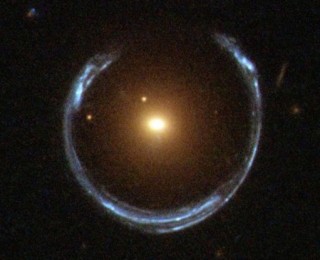
I recently attended a two-week crash course in the “Astrophysical Applications of Gravitational Lensing”. In this post, I overview a few of the ways astronomers employ lensing to study the Universe, from extrasolar planets to distant quasars and large-scale structure.
by Chris Faesi | Nov 23, 2012 | Daily Paper Summaries
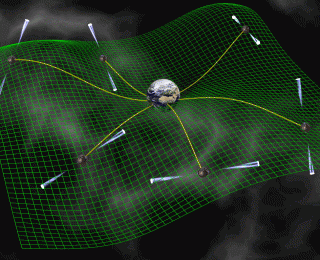
The race to be the first to detect gravitational waves is on – are pulsar timing arrays on the verge of a discovery? New predictions based on revised galaxy merger calculations suggest that it may be so.
by Alice Olmstead | Oct 22, 2012 | Daily Paper Summaries
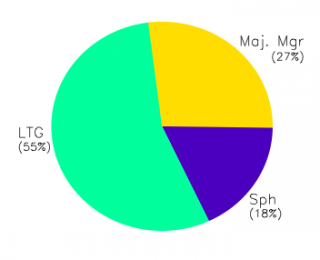
In this study, Kaviraj et al. find that major mergers only contribute a small percentage (17-27%) of the total star formation at a redshift of 2, when the Universe was 3.3 billion years old and vigorously creating new stars. This goes against what we once thought, and leaves the door open for other mechanisms to drive the global star formation rate in the early Universe.
