by Chris Faesi | Apr 29, 2014 | Daily Paper Summaries
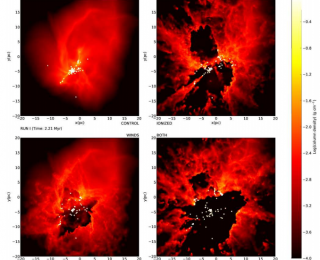
Massive stars emit energetic radiation and expel strong winds that can disrupt their natal environments. New simulations show that these effects are important in the evolution of stellar nurseries and can account for some of the observed low efficiency of star formation.
by Anson Lam | Feb 24, 2014 | Daily Paper Summaries
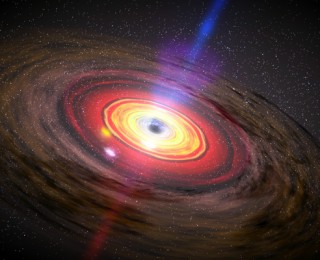
By looking at the spectral changes of the accretion disk emission around black holes, we can trace the physical changes of the accreting material.
by Brett Deaton | Feb 23, 2014 | Daily Paper Summaries
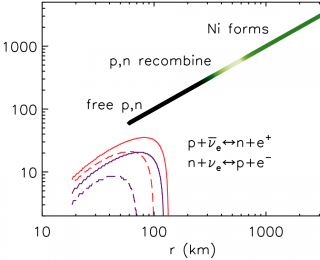
There aren’t many places in the universe that you can find a bunch of free neutrons not already trapped inside a nucleus—except in neutron stars. Luckily, neutron stars in violent mergers with other neutron stars, or with black holes, tend to disperse a little bit of their matter into the interstellar medium. Tidal forces eject some matter as the two objects swing around each other in their final orbits. Then, if an accretion disk forms, winds blown off the surface of the disk disperse even more matter. Surman and her colleagues look at the nucleosynthesis that occurs in this latter process, and find something surprising.
by Anson Lam | Jan 27, 2014 | Daily Paper Summaries
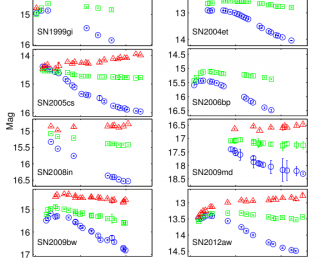
By examining their expansion rate over time, Type II supernovae provide a way to measure extragalactic distances.
by Brett Deaton | Nov 20, 2013 | Daily Paper Summaries
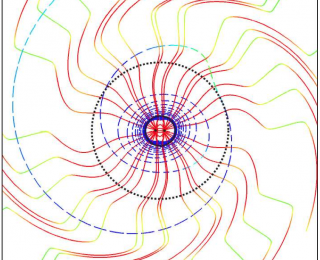
Field lines are a powerful tool for building intuition for a complex geometric object.
by Kim Phifer | Feb 5, 2013 | Daily Paper Summaries
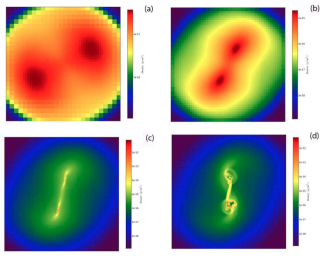
Boss & Keiser examine how magnetic fields with varying initial conditions affect star formation.
