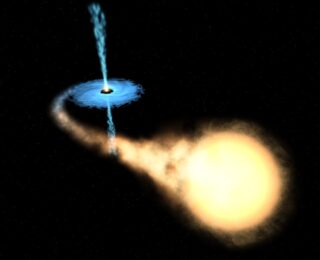
Simulations of Turbulence in Black Hole Coronae
In today’s bite, the authors use simulations to explore turbulence a possible mechanism for the observed x-ray emissions in the coronae of black holes.

In today’s bite, the authors use simulations to explore turbulence a possible mechanism for the observed x-ray emissions in the coronae of black holes.

In this Astrobite, the authors study the effects of dark matter on merging black hole binaries. As the black holes move through dark matter, they form wakes that slow them down, could this affect the gravitational waves released?
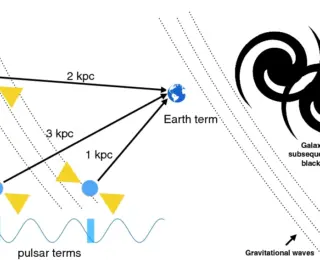
Pulsar timing arrays could localise individual sources of gravitational waves to host galaxies. The problem is, it’s so computationally difficult! This paper shows us a faster way.
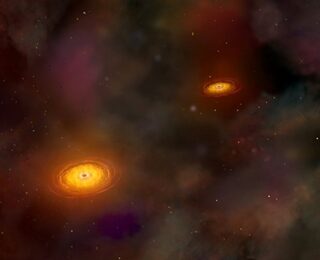
Are dual active galactic nuclei (AGN) hiding away together behind gas as they spiral in towards each other?
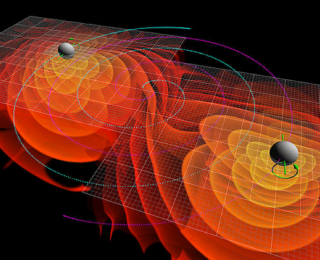
In this Astrobite, we see if gravitational waves can help us find theoretical horizonless compact objects, exotic objects predicted by modern alternatives to General Relativity!
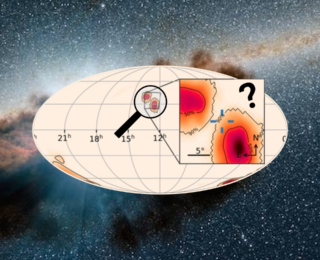
In today’s paper, a unique gravitational wave event is re-examined as the possible origin of an AGN flare. What are the odds?