by Shannon Hall | Sep 16, 2012 | Daily Paper Summaries
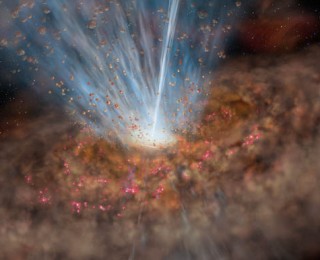
In the nearby Universe, massive galaxies contain very little interstellar gas and old stellar populations. But theoretical models predict that such galaxies should have much younger stellar populations. In order to solve this discrepancy models invoke quasar outflows in the early Universe. Such outflows would expel the gas from a galaxy and quench star formation. Presented here are the results from the first massive quasar outflow observer at z ~ 6.4189.
by Kirit Karkare | Sep 11, 2012 | Daily Paper Summaries
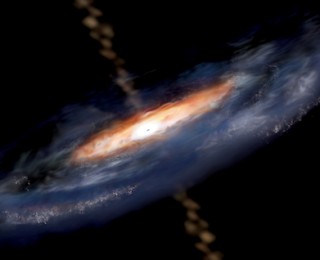
Active galactic nuclei are some of the most luminous objects in the universe. This paper explores how feedback from AGN could trigger star formation in their host galaxies.
by Kim Phifer | Jul 2, 2012 | Daily Paper Summaries
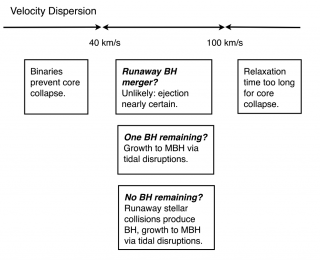
Miller & Davies investigate whether central black holes should exist in low mass stellar systems such as globular clusters.
by Alice Olmstead | May 9, 2012 | Daily Paper Summaries
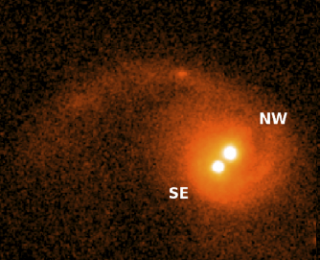
It has long been known that galaxies can merge; thus, we should expect their central supermassive black holes to interact as well. However, our ability to study this is limited as most mergers happen in the distant universe. The exceptional nearby source CID-42 can be explained by a recent binary or triple supermassive black hole interaction, giving astronomers a rare chance to witness the repercussions of such an event.
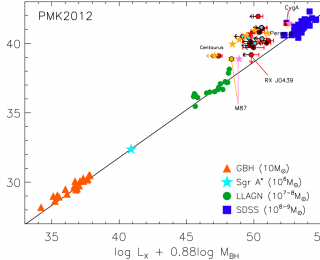
by Allison Strom | May 7, 2012 | Daily Paper Summaries
A team of astronomers at the University of Cambridge have uncovered evidence for ultramassive black holes in the giant elliptical galaxies that sit at the center of galaxy clusters. These whoppers could be up to ten times more massive than ordinary supermassive black holes, like the ones we usually find in centers of galaxies.
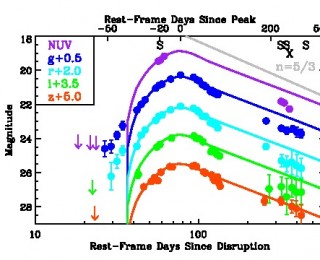
by Lucia Morganti | May 5, 2012 | Daily Paper Summaries
A luminous ultraviolet-optical flare of radiation reveals the tidal disruption of a star wandering on a quasi-parabolic orbit in the vicinity of a supermassive black hole. This is the most direct evidence yet of a supermassive black hole shredding a star that swirled too close.
