by Elisa Chisari | Dec 11, 2013 | Daily Paper Summaries
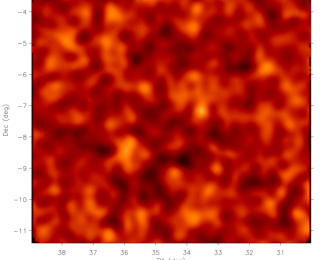
Gravitational lensing is the deflection of the trajectory of a photon by gravity, and it is a natural consequence of the theory of General Relativity. Lensing distorts the shapes and orientations of galaxies and in today’s post, we discuss a new method to reconstruct dark matter maps of our Universe using the position angles of galaxies.
by Guest | Oct 24, 2013 | Daily Paper Summaries
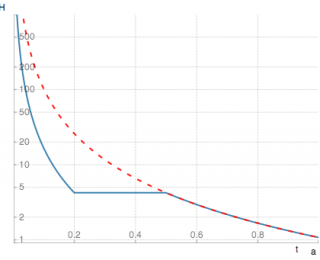
Today’s post is a guest contribution from Dr. Andrew Pontzen, a Royal Society University Research Fellow at University College London and an expert in galaxy formation and cosmology. Andrew is also a leader in the use of fantastic visualizations and interactive graphics as explanatory and teaching tools, and in this post he uses this approach to provide a new look at the cosmological concept of inflation. Loading the post. If this message doesn’t disappear, please check that javascript is enabled in your browser. Cosmic inflation is a hypothetical period in the very early universe designed to solve some weaknesses in the big bang theory. But what actually happens during inflation? According to wikipedia and other respectable sources, the main effect is an ‘extremely rapid’ expansion. That stock description is a bit puzzling; in fact, the more I’ve tried to understand it, the more it seems like inflation is secretly all about slow expansion, not rapid expansion.The secret’s not well-kept: once you know where to look, you can find a note by John Peacock that supports the slow-expansion view, for example. But with the rapid-expansion picture so widely accepted and repeated, it’s fun to explore why slow-expansion seems a better description. Before the end of this post, I’ll try to recruit you to the cause by means of some crafty interactive javascript plots. A tale of two universes There are many measurements which constrain the history of the universe. If, for example, we combine information about how fast the universe is expanding today (from supernovae, for example) with the known density of radiation and matter (largely from the cosmic microwave...
by Chris Faesi | Oct 9, 2013 | Daily Paper Summaries
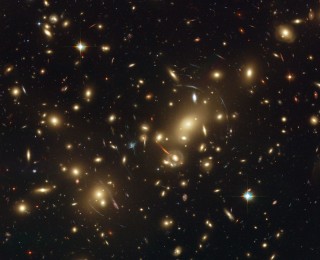
New results from stacked weak lensing measurements of over a hundred thousand galaxies show that, on large scales, light from stars appears to trace the dark matter distribution of the Universe remarkably well.
by Guest | Aug 4, 2013 | Classics, Daily Paper Summaries
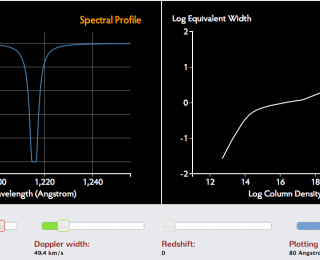
Our special guest astrophysical classics series on Gunn & Peterson 1965 concludes with an examination — and apprehension — of the suspects responsible for reionization.
by Elisa Chisari | Jul 24, 2013 | Daily Paper Summaries
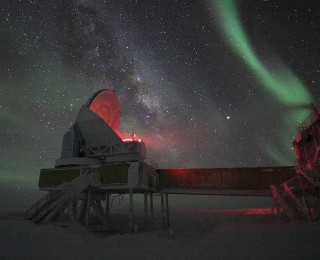
Gravitational lensing causes distortions in the polarization of the Cosmic Microwave Background. In this astrobite, we discuss recent results from the South Pole Telescope collaboration measuring patterns caused by lensing in the CMB polarization. What do these patterns tell us about the Universe?
by Kirit Karkare | Jul 23, 2013 | Daily Paper Summaries
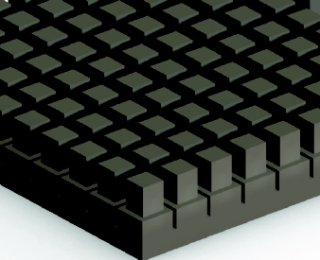
Anti-reflection coatings aren’t just for your glasses — telescope lenses need them too! Here we look at a new technique for reducing reflections in lenses made of silicon.
