by Guest | Jul 21, 2013 | Classics, Daily Paper Summaries
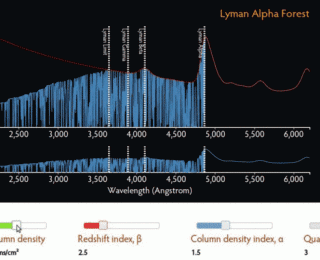
Gas in the Universe went from being mostly neutral to mostly ionized as the first galaxies formed, and the signature of this process is imprinted in quasar spectra. The review of the classic paper by Gunn & Peterson continues in this second in the three-part series.
by Guest | Jul 14, 2013 | Classics, Daily Paper Summaries
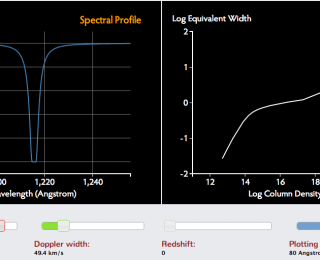
This guest post, the first in a three-part series, reviews the classic article by Gunn & Peterson (1965). This paper proposed several fundamental ideas in cosmology, including using distant quasars as “flashlights” to observe the diffuse gas between galaxies.
by Elisa Chisari | May 25, 2013 | Daily Paper Summaries
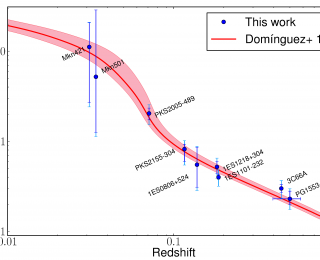
In today’s astrobite, we discuss the opacity of the Universe to high energy photons. The cosmic gamma-ray horizon, constrained by the authors of this paper, is a measure of this opacity, a cosmological probe and means of estimating blazar redshifts.
by Kirit Karkare | Apr 29, 2013 | Daily Paper Summaries
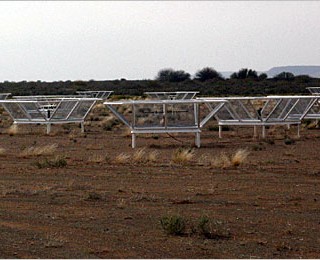
An array of dipole antennas in South Africa’s Karoo desert offers the best limit on the power spectrum of the Epoch of Reionization.
by Nick Hand | Apr 21, 2013 | Daily Paper Summaries
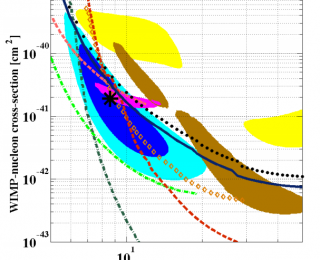
The Cryogenic Dark Matter Search experiment has found signatures in its data consistent with a dark matter Weakly Interacting Massive Particle. While not confident enough to declare a dark matter discovery, they estimate that there is only a 0.2% chance that these signatures are caused by random chance.
by Allison Strom | Apr 13, 2013 | Daily Paper Summaries
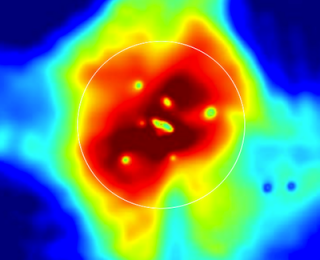
Moving mesh code AREPO looks like it will help astronomers understand the physics of galaxy formation and evolution better than its predecessors, due to an innovative new method of solving the fluid dynamics equations in astrophysical settings. This paper discusses the differences between AREPO and another code called GADGET in the case of gas accretion onto galaxies.
