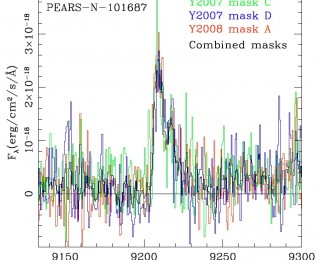
Finding Galaxies at the Edge of the Universe
How can we find the distant galaxies that were responsible for bringing us out of the cosmic dark ages?

How can we find the distant galaxies that were responsible for bringing us out of the cosmic dark ages?
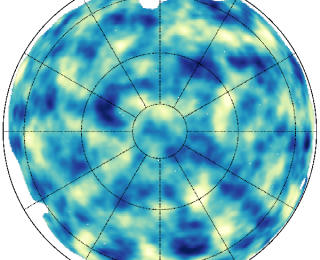
In today’s astrobite, we continue our overview of the papers from the Planck 2013 release. This time, we review papers XVII and XXIII, which discuss weak gravitational lensing of the Cosmic Microwave Background, and the isotropy of the Universe at the time this background radiation was emitted.
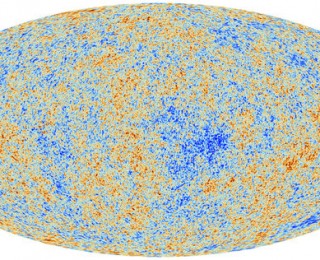
The primordial seeds of the Universe, the Cosmic Microwave Background, have been measured by the Planck satellite with unprecedented precision. In this post, we summarize some of their results on cosmological parameters and primordial non-gaussianity.
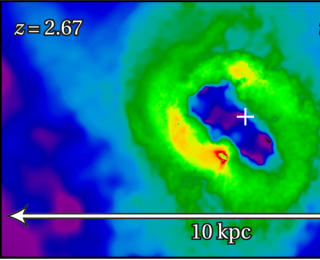
What were astronomers reading and talking about in their research last year? Check out figures from the top 12 most-cited astronomy papers from 2012 (so far) and find out what researchers were up to and why!
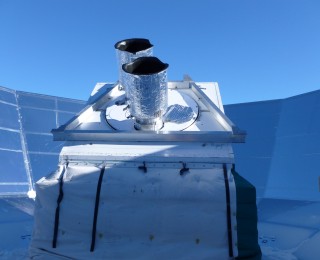
I’m spending a month working on a telescope at the South Pole. In this post, we take a tour of the two observatory buildings hosting Cosmic Microwave Background experiments.
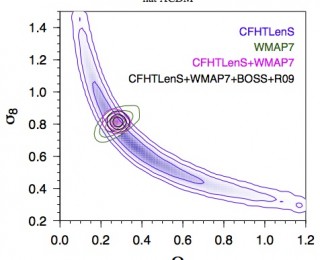
The Canada-France Hawaii Telescope weak gravitational lensing survey (CFHTLens), recently released new results to help constrain our cosmological models. While still in its early stages, weak lensing will ultimately be a powerful tool to discover the nature of the mysterious dark energy.