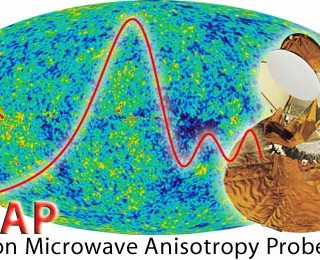
WMAP’s Closing Comments: ΛCDM Stands Strong
The final results from the WMAP satellite show agreement with the standard model of cosmology to unprecedented precision.

The final results from the WMAP satellite show agreement with the standard model of cosmology to unprecedented precision.
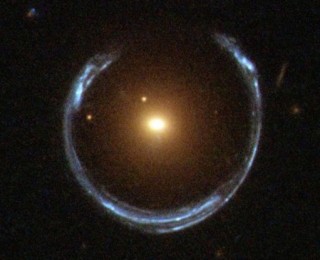
I recently attended a two-week crash course in the “Astrophysical Applications of Gravitational Lensing”. In this post, I overview a few of the ways astronomers employ lensing to study the Universe, from extrasolar planets to distant quasars and large-scale structure.
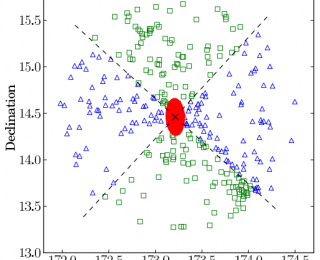
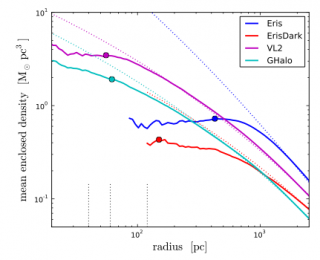
As Astrobites reported a couple of months ago, the Fermi-LAT gamma-ray telescope has reported an anomalous peak at 130 GeV, which could be the long-sought annihilation signature of dark matter. However, one of the strongest critiques of this potential discovery is that the signal is not coming from Sgr A*, the dynamical center of the Milky Way, but rather from about 200 parsecs away. Kuhlen et al. challenge the idea that the dark matter peak must be located at the dynamical center, and find that the combined dark matter-baryonic matter simulation Eris shows a well-defined, consistent offset between its dark matter peak and dynamical center.
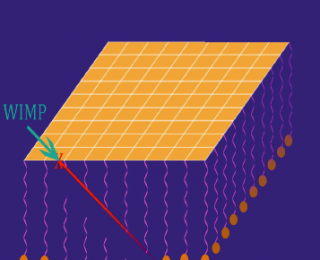
Can DNA be used to detect dark matter? Guest author Elisa Chisari explains how biology and physics can combine to teach us more about the universe.
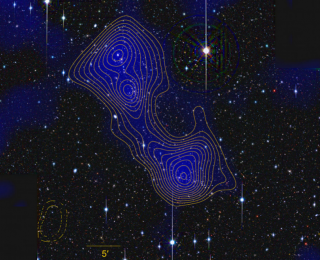
Throughout much of the 20th century, it was an open question in astronomy as to what the universe looked like on the largest observable scales. Were galaxies and galaxy clusters distributed uniformly throughout space, or was there a pattern? Thanks to galaxy surveys we know that, on large scales, the matter distribution of the universe is clumpy instead of smooth. Through these surveys we observe directly the distribution of luminous matter like stars, gas, and galaxies. However, luminous matter comprises only a small fraction of the matter in the universe (17%), the rest is dark matter which interacts via gravity but does not absorb and emit electromagnetic radiation like normal matter. Theoretical simulations of dark matter cosmologies firmly predict that there is a dark matter backbone to the cosmic web, with filaments of dark matter stretching between clusters of galaxies, though has not yet been a robust detection of a dark matter filament, until now.