by Nathan Sanders | Jun 19, 2012 | Daily Paper Summaries
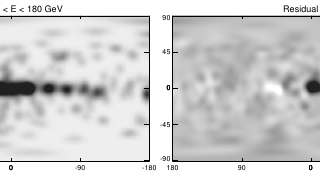
A flurry of recent papers point to detection of a ~130 GeV gamma-ray emission line from near the Galactic center. If real, this could be the first detection of a signature of annihilating dark matter.
by Susanna Kohler | Apr 19, 2012 | Daily Paper Summaries
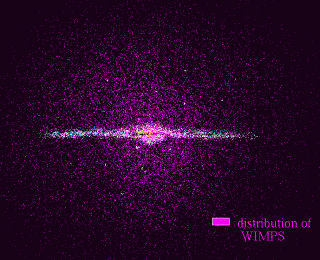
If WIMPs are the solution to the dark matter problem, it’s reasonable to ask what sort of impact they would have on human beings. This paper answers that question.
by Maria Drout | Feb 8, 2012 | Daily Paper Summaries
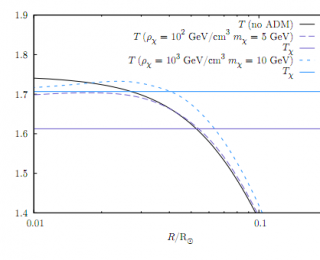
What happens to the structure and properties of a star in a the presence of dark matter?
by Elizabeth Lovegrove | Jan 17, 2012 | Daily Paper Summaries
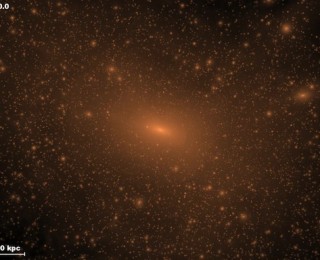
Dark matter is not so dark as the name might imply. Although it so far refuses to interact with normal matter via any force other than gravity, there are secondary signals that we can detect. When we turn our gamma-ray telescopes on regions like the Galactic Center that contain a high density of dark matter, we expect to see a dim, widespread gamma ray haze coming from seemingly empty space, with no baryonic matter source. This paper, due to be published by the Astrophysical Journal, discusses the search for this signature by the collection of satellites that surrounds the Milky Way, and uses the lack of a detection to set an upper limit on the cross-section of the WIMP particle.
by Elisabeth Newton | Jan 9, 2012 | Current Events
Simulations tell us of a web-like Universe but it’s hard to explore this topic observationally because we can’t see dark matter. But the Canada-France-Hawaii Telescope (CFHT) Lensing Survey has made the first large scale map of dark matter. On the first day of AAS #219, the CFHTLenS survey shared their results with us.a
by Allison Strom | Dec 16, 2011 | Daily Paper Summaries
Conference proceedings from the 2011 Fermi Symposium highlight some of the major science applications of the gamma-ray space observatory.
