by David Wilson | Sep 28, 2015 | Daily Paper Summaries
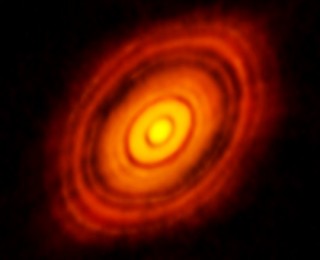
Nearly a year ago, the ALMA collaboration released this stunning image of the young star HL Tau. The sub-millimeter wavelengths of light that ALMA detects revealed a vast disc of gas and dust, several times larger than Neptune’s orbit. Intriguingly, the disc was divided up into a series of well-defined, concentric rings.
The cause of the rings seemed clear: There must be planets around HL Tau, their gravity sculpting the gas and sweeping out the dark gaps in the disc.
by Nick Ballering | Oct 13, 2014 | Daily Paper Summaries
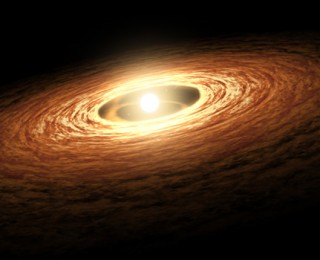
There does not seem to be enough mass in protoplanetary disks to build the planetary systems we’ve detected. The solution: planet formation might start sooner than previously thought.

by Nick Ballering | Aug 18, 2014 | Daily Paper Summaries
Herschel provides an updated look at the debris disk in the popular planetary system, Tau Ceti.
by Nick Ballering | Mar 31, 2014 | Daily Paper Summaries
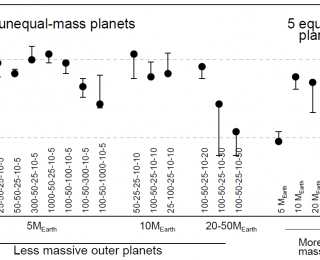
Vega’s system of debris disks can be explained by a series of planets that constantly transport material inwards towards the star.
by Nick Ballering | May 21, 2013 | Daily Paper Summaries
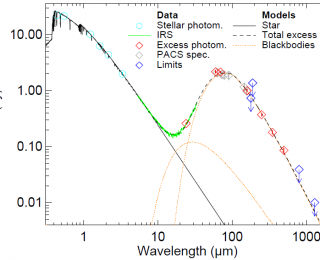
The disk around 49 Ceti is known to show characteristics of both protoplanetary and debris disks. New observations with Herschel reveal that it is likely a debris disk with gas generated by evaporating comets.
by Susanna Kohler | Feb 1, 2013 | Daily Paper Summaries
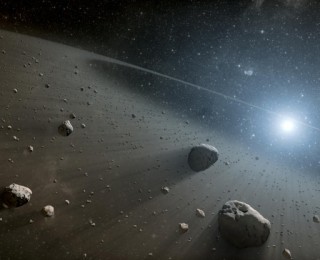
We’ve detected planets around pulsars before, but this pulsar has an even stranger signal. Could it be due to an asteroid belt similar to the one in our solar system orbiting it?
