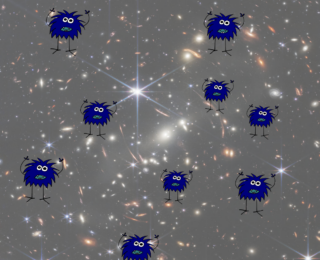
Did blue monster galaxies in the early universe sweep away their dust?
Massive blue galaxies in the early universe present a dusty puzzle. Is the dust in these galaxies being ejected, or is it squirreled away in giant molecular clouds?

Massive blue galaxies in the early universe present a dusty puzzle. Is the dust in these galaxies being ejected, or is it squirreled away in giant molecular clouds?

Today’s paper uses simulations to understand how the Milky Way’s stellar halo formed, and also asks: what determines the evolutionary pathway taken by a galaxy over cosmic time?
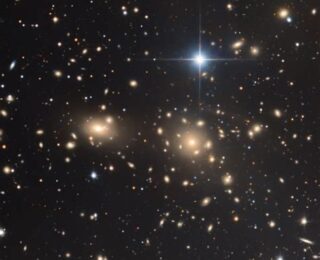
Could dark matter behave similarly to regular matter? If so, could dark matter halos collapse and form structures, like a black hole? In this work we explore the Atomic Dark Matter Model and predicting structure formation in it using simple algebra. We build on the current literature by showing that for certain values of the variables that govern dark matter interactions, we won’t be able to determine if the halo will be able to collapse using methods to track the dark matter number densities and how efficiently the halo can dispose of its initial energy.
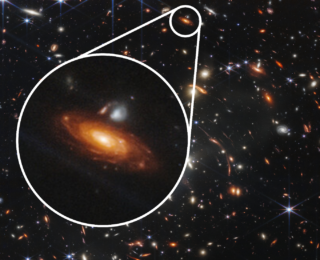
Brand new data could force us to re-think how galaxies form and evolve in the early Universe — but there’s no need to panic!

How do supermassive black holes get to be so supermassive? Today’s authors explore how we might be able to answer that question with the SKA pulsar timing array!
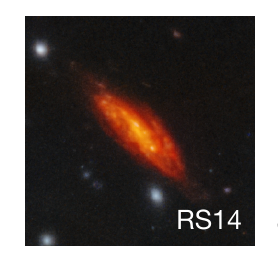
JWST is currently revealing many previously unseen or undiscovered properties of our Universe. Even in the very first image released, three red spiral galaxies, which are super rare in our local Universe, can now be seen and analyzed down to structural details as never before. What can these weird galaxies tell us about the so-called cosmic noon and the evolution of galaxy formation?