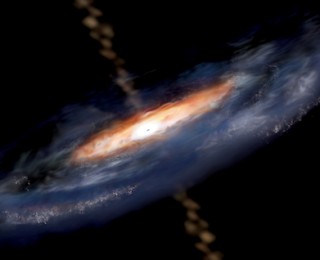
Does AGN feedback trigger star formation?
Active galactic nuclei are some of the most luminous objects in the universe. This paper explores how feedback from AGN could trigger star formation in their host galaxies.

Active galactic nuclei are some of the most luminous objects in the universe. This paper explores how feedback from AGN could trigger star formation in their host galaxies.
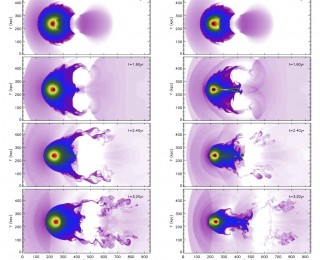
Most simulations to date have implied that satellite galaxies traveling through galaxy clusters are stripped of gas for future star formation in a process known as “strangulation”. In contrast, the authors of this paper suggest that satellite galaxies may not be as cut off as some might think: instead, their simulations show that the cooler, stripped gas from the corona will mix with the surrounding intra-cluster medium and remain near the original galaxy as a potential new source of star-forming fuel.
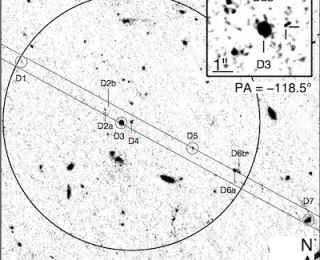
Using a combination of spectra from gamma-ray burst afterglows and photometry and spectroscopy of nearby objects, astronomers have found the galaxy counterpart to at least one high-redshift absorption system, bumping the total number of such galaxies from nine to ten.
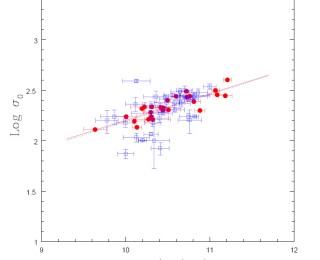
Tight relationships between galactic properties seem to depend on environment.
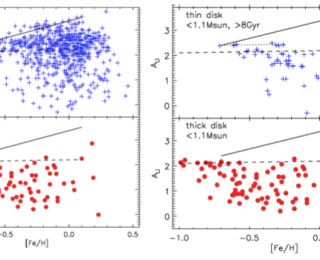
Is there a link between lithium abundance, galactic chemical evolution, and exoplanets? Ramirez et al. examine metallicities, lithium abundances, and stellar characteristics of 1381 Sun-like stars to find out.
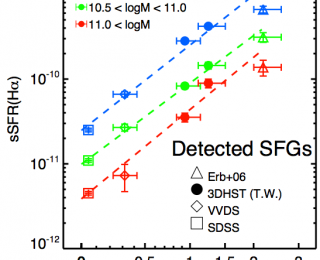
Astronomers in Leiden have measured star formation rates across a large range in redshift with H-alpha spectroscopy for the first time, which is a huge leap forward in our ability to compare the local Universe with high-redshift.